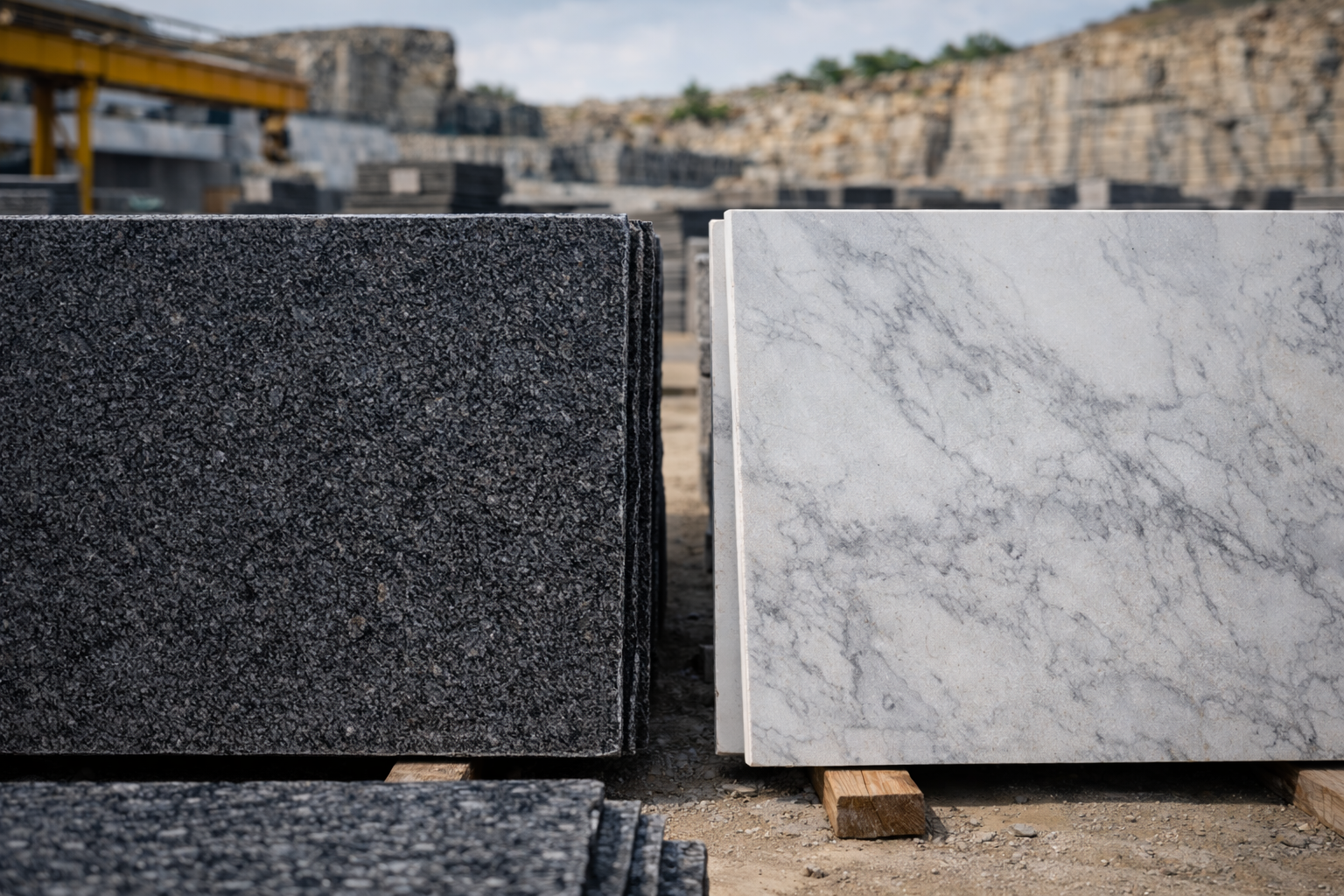
The New Competitor: Engineered Porcelain Slabs
Over the past decade, engineered porcelain slabs (marketed under brands like Dekton, Neolith, Laminam, and others) have emerged as the most significant competitor to natural granite in the countertop, cladding, and surface market. These manufactured products are designed to replicate the appearance of natural stone while offering specific technical properties. For architects, fabricators, and buyers, understanding the real differences between natural granite and porcelain slabs is essential for making informed specification decisions.
This comparison is honest about both materials' strengths and limitations.
What Are Porcelain Slabs?
Engineered porcelain slabs are manufactured from a blend of clays, feldspar, silica, and mineral pigments. The raw materials are pressed under extreme pressure (up to 25,000 tonnes) and fired at temperatures exceeding 1,200°C. The result is a dense, non-porous, consistent product available in large formats (up to 3,200 x 1,500 mm) and thicknesses from 6 mm to 20 mm.
The surface pattern is either through-body (consistent colour through the full thickness) or digitally printed (a high-definition image applied to the surface and sealed during firing). Printed surfaces can closely replicate the appearance of marble, granite, concrete, wood, and other materials.
Property Comparison
Scratch Resistance
Both perform well. Granite (6-7 Mohs) and premium porcelain slabs (6-7 Mohs) offer comparable scratch resistance for everyday use. Both materials resist scratching from kitchen knives, keys, and normal household objects. Neither material should be used as a cutting surface (use cutting boards), but both will withstand accidental contact without visible damage.
Stain Resistance
Porcelain has a slight edge. Engineered porcelain slabs are virtually non-porous (water absorption below 0.05%), making them highly stain-resistant without any sealing. Natural granite is also highly stain-resistant (water absorption 0.08-0.20% for Rustenburg), but benefits from periodic sealing to maintain maximum stain protection. In practical terms, both materials perform excellently in kitchen and bathroom environments. The difference only becomes relevant in extreme conditions (prolonged contact with strong staining agents without cleaning).
Heat Resistance
Granite wins marginally. Natural granite handles direct heat contact (hot pots, pans) without damage in normal kitchen use. Porcelain slabs also handle heat well, but some manufacturers advise using trivets for very hot cookware to avoid potential thermal shock. In practice, both materials perform adequately for kitchen applications.
Impact Resistance
Granite wins. This is one of the most significant practical differences. Natural granite's crystalline structure gives it excellent impact resistance — dropped objects, accidental impacts, and point loads that would chip or crack a porcelain slab are typically absorbed by granite without damage. Porcelain slabs, despite their hardness, are more brittle. A heavy pot dropped on a porcelain countertop edge can cause chipping or cracking that is very difficult to repair. The thinner the porcelain slab (6 mm and 12 mm formats), the more vulnerable it is to impact damage.
Repairability
Granite wins decisively. If natural granite is chipped or scratched, the damage can often be repaired by a skilled stone fabricator. Minor chips can be filled with colour-matched epoxy, and scratches can be polished out. The stone's consistent colour through its full thickness means repairs blend into the surrounding material.
Porcelain slab damage is far more difficult to repair. If a printed porcelain surface is chipped, the clay body beneath the print is exposed — a different colour and texture from the surface. Repairs are visible and unsatisfactory. In most cases, significant damage to a porcelain slab requires full panel replacement, which is costly and may not match the original if the design pattern has been discontinued.
Colour Consistency Through Depth
Granite wins. Natural granite is consistent through its entire thickness. Cut it, chip it, or expose any cross-section, and the colour and pattern are the same throughout. This is inherent to natural stone and cannot be replicated by manufacturing.
Most porcelain slabs rely on a digitally printed surface layer (typically 1-3 mm of visual depth). The body beneath is a uniform clay colour — typically white, beige, or grey. Any damage that penetrates the printed layer exposes this dissimilar body. Through-body porcelain products exist but offer limited pattern complexity and do not replicate the visual depth of natural stone.
Aesthetics and Authenticity
Subjective, but natural stone has an inherent advantage. Modern porcelain printing technology produces remarkably convincing stone-look surfaces when viewed from a distance. However, under close inspection, natural stone reveals a depth, mineral complexity, and subtle variation that printed surfaces cannot fully capture. Each granite slab is unique — a genuine geological product with two billion years of history visible in its mineral structure. Porcelain is a manufactured product designed to replicate this appearance, and discerning buyers can tell the difference.
This matters commercially. Premium buyers, luxury property developers, and prestige hospitality projects consistently specify natural stone specifically because it is genuine. The material authenticity of natural stone has a market value that manufactured alternatives do not share.
Environmental Considerations
Granite has a simpler environmental profile. Natural granite is quarried, cut, and finished mechanically. No chemical processing, no firing at extreme temperatures, and no synthetic materials are involved. The energy consumption of granite production is primarily mechanical (cutting and polishing).
Porcelain slab manufacturing requires high-temperature firing (1,200°C+), which demands significant energy input. The digital printing process involves ceramic inks and glazes with complex chemical compositions. The carbon footprint per square metre of manufactured porcelain typically exceeds that of quarried and processed natural granite.
Cost
Comparable at the product level; granite wins on lifecycle cost. Premium porcelain slabs are priced similarly to mid-range granites. Top-tier porcelain brands can exceed the price of standard Rustenburg granite. When fabrication and installation costs are included, the total project cost is often comparable between the two materials.
However, granite's superior repairability and longevity give it a lifecycle cost advantage. A granite countertop installed today will still be performing in 50 years. A porcelain slab may require replacement if damaged, with replacement cost and potential design discontinuation adding to the lifecycle expense.
Where Natural Granite is the Better Choice
- Kitchen countertops — Where impact resistance and repairability matter daily
- High-traffic commercial floors — Where long-term durability and repair options are essential
- Exterior applications — Where material authenticity and UV resistance are paramount
- Premium residential and hospitality projects — Where material genuineness is a specification requirement
- Any project valued on authenticity — Where buyers expect real natural materials, not replicas
Where Porcelain Slabs May Be Appropriate
- Ultra-thin wall cladding — Porcelain's 6 mm format enables cladding where granite's weight would be prohibitive
- Highly specific colour matching — If a project requires an exact colour that doesn't exist in natural stone
- Budget commercial fitouts — Where the appearance of natural stone is desired but the project budget does not support genuine stone
- Outdoor kitchen surfaces — Where zero porosity is prioritised over impact resistance
The Bottom Line
Porcelain slabs are competent manufactured products that serve a market segment. But they are a replication of natural stone, not a replacement for it. For projects where material authenticity, repairability, long-term durability, and genuine geological character matter, natural granite remains the superior choice.
See the Difference
Visit Afrika National Granite at 8 Dekenah Road, Alrode, Alberton to compare natural granite with any alternative. When you see and feel the depth and character of real stone, the difference is immediately apparent. Contact us today to discuss your project specifications.