Natural Stone as a Landscape Design Material
For landscape architects, the choice of hardscape material defines the character, quality, and longevity of outdoor spaces. Natural granite offers properties that no manufactured alternative can fully replicate: geological authenticity, colour permanence, structural strength measured in centuries, and a visual depth that evolves subtly with age and patina. These qualities make granite the default specification for prestige landscape projects globally.
This guide provides landscape architects and landscape designers with the technical information needed to specify natural granite confidently across the full range of hardscape applications — from paving and walling to water features and bespoke stone elements.
Material Properties Relevant to Landscape Specification
Understanding granite's physical properties informs appropriate specification decisions:
- Compressive strength: 180-260 MPa (Rustenburg granite). Exceeds the structural demands of any landscape application.
- Water absorption: 0.08-0.20%. Near-impermeable, making granite highly resistant to frost damage (critical for European export markets) and water staining.
- Density: 2,900-3,050 kg/m³. The high density contributes to durability, sound quality (important for fountain elements), and resistance to displacement under traffic loads.
- Mohs hardness: 6-7. Highly resistant to abrasion from foot traffic, vehicle tyres, and maintenance equipment.
- UV resistance: Absolute. Natural granite does not fade, yellow, or degrade under UV exposure. Colour permanence is guaranteed for the life of the stone.
- Chemical resistance: Resistant to most environmental chemicals. Unaffected by road salt, pool chemicals (at typical concentrations), and organic acids from plant matter.
Paving Specification
Design Intent and Format Selection
The paver format establishes the visual rhythm and character of the paved surface:
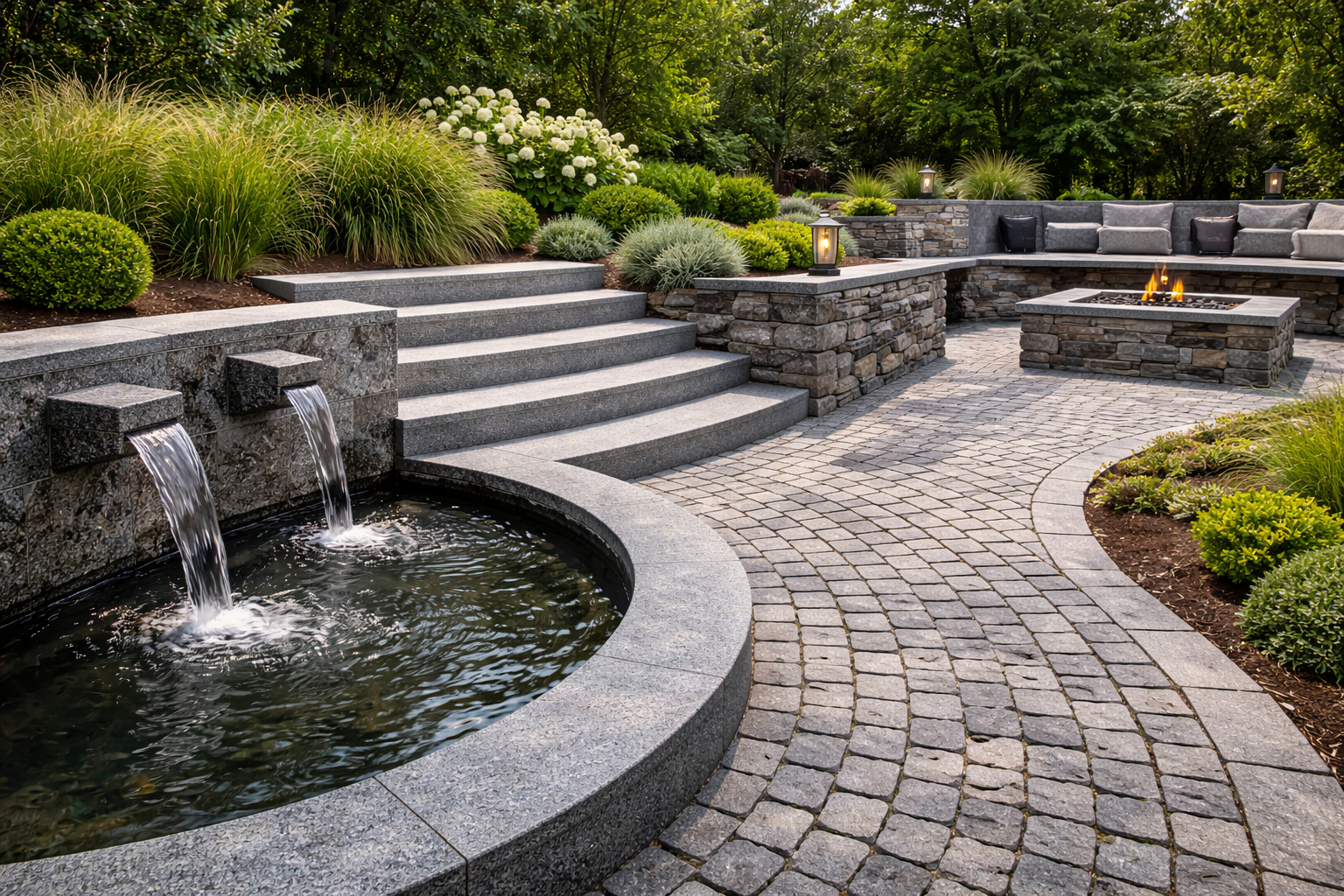
- Cobblestones (100 x 100 x 100 mm cubes) — Traditional, heritage character. Fan patterns, arcs, and curves. Best for intimate courtyard spaces, heritage projects, and European-influenced designs.
- Small-format pavers (200 x 100 mm) — Versatile. Herringbone, stretcher bond, basket weave. Works in both traditional and contemporary contexts.
- Medium-format pavers (300 x 300, 400 x 200 mm) — Contemporary. Grid and linear layouts. Clean, modern aesthetic for urban and residential landscapes.
- Large-format pavers (600 x 300, 600 x 400 mm) — Minimal joint lines, expansive visual character. Premium residential and commercial landscapes. Requires precise sub-base preparation.
- Random coursing (mixed widths, fixed length) — Natural, organic character. Combines regularity with variation. Effective for garden paths and transition zones between formal and informal areas.
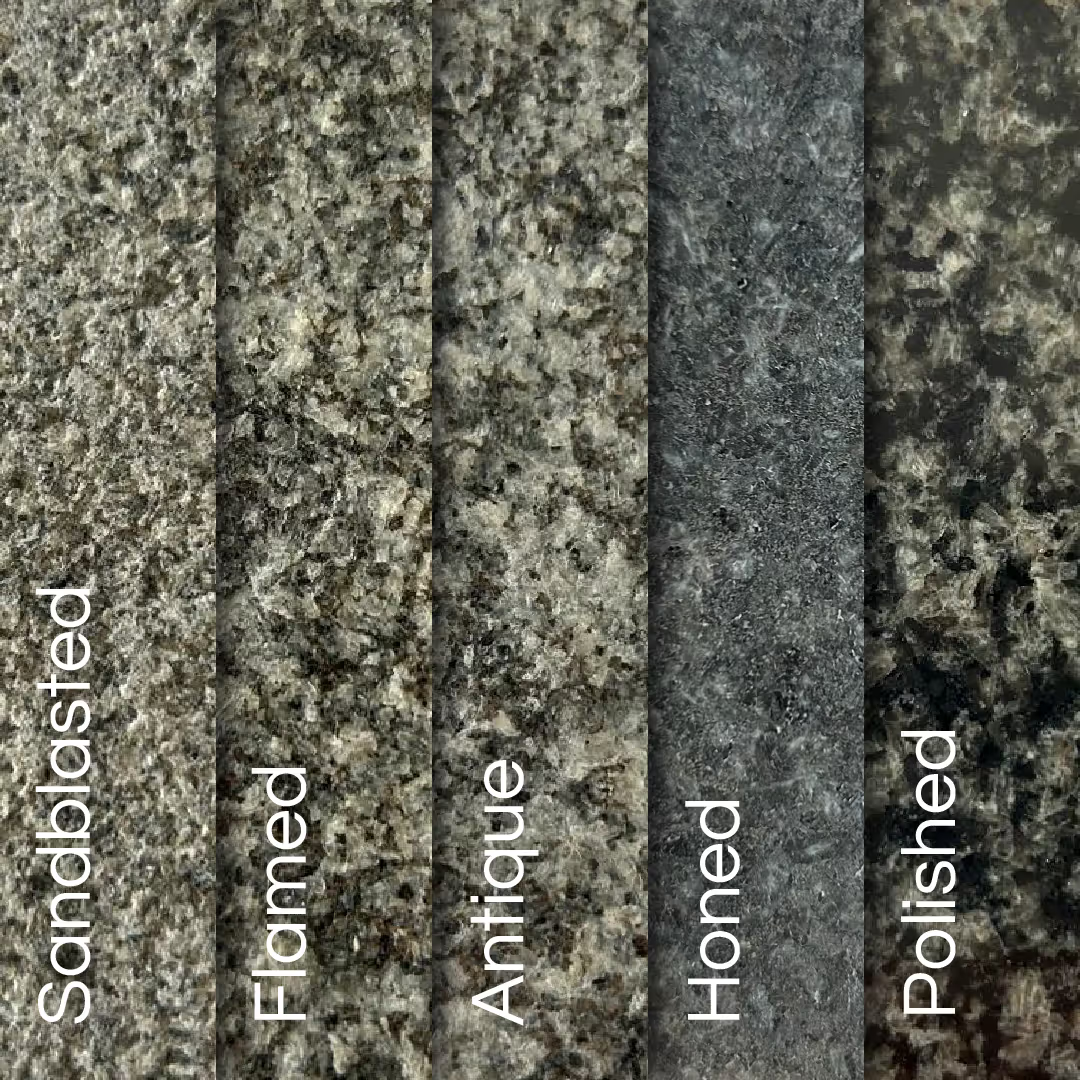
Finish Selection for Landscape
- Flamed — The workhorse finish for landscape paving. Consistent slip resistance, natural texture, UV-stable appearance. Suitable for all external applications.
- Bush-hammered — More heavily textured than flamed. Creates a robust, tactile surface for public realm projects, commercial plazas, and areas requiring maximum traction.
- Sawn and sandblasted — Clean-cut precision with a textured top surface. Contemporary aesthetic for modern landscape designs. The clean edges create tight, precise joint lines.
- Natural split (cleft) — Rough, irregular surface with authentic geological character. Heritage projects, naturalistic garden designs, and dry-stone-style paving.
- Honed — Smooth matte finish for covered external areas (covered terraces, porte cocheres) where slip risk is managed by shelter. Not recommended for exposed external paving.
Walling Specification
Granite walling elements include retaining walls, boundary walls, seat walls, raised planters, and free-standing feature walls:
Dry-Stack Walling
Granite blocks (typically 200-400 mm long, 100-200 mm high, 150-300 mm deep) stacked without mortar. The weight and interlock of the blocks provides structural stability. Suitable for retaining walls up to approximately 800-1,000 mm in height, seat walls, and garden edging. The open joints allow water drainage and create a naturalistic appearance that suits informal garden settings.
Mortared Walling
Granite blocks bedded in mortar for structural retaining walls (up to 1,200 mm without engineering design), boundary walls, and formal garden features. Mortar joints can be raked (recessed) for a shadow-line effect or flush-pointed for a cleaner appearance.
Cladding on Concrete Core
For taller retaining walls (above 1,200 mm) or walls requiring specific engineering design, a reinforced concrete core wall is clad with split-face or sawn granite panels. This approach provides structural engineering certainty with the natural beauty of stone facing.
Block Formats
- Split-face blocks — Rough, natural face exposed. Textured, characterful appearance. The most popular format for landscape walling.
- Sawn blocks — Clean, precise faces. Contemporary, architectural appearance. Works well with honed or flamed face finishes.
- Random ashlar — Blocks of varying heights in courses of consistent length. Creates a natural, organic wall pattern with horizontal coursing lines.
Water Feature Specification
Granite's impermeability, weather resistance, and visual gravitas make it ideal for landscape water features:
Swimming Pool Surrounds
- Copings: Flamed or bush-hammered granite copings provide slip resistance, durability, and a premium finish. Standard profiles include bullnose (pool edge), square with chamfer, and drop-face (extends down inside the pool edge). Width: typically 300-400 mm.
- Paving: Flamed granite pavers around the pool surround. Specify a non-slip finish with minimum PTV 45 for all pool paving.
- Colour stability: Granite is unaffected by pool chemicals (chlorine, salt chlorination, UV). The stone will not discolour or degrade.
Fountains and Water Walls
Granite can be specified for fountain basins, water walls, cascade elements, and scupper details. For water contact applications:
- Seal all surfaces in contact with water with a waterproof stone sealer
- Polished and honed finishes showcase the stone's colour depth when wet
- Consider the visual effect of water on the stone — wet granite appears darker and richer than dry stone
Rills and Water Channels
Precision-cut granite channels for formal rill features. Typically 100-200 mm wide, 50-80 mm deep, cut from solid granite. Create elegant linear water elements in formal garden designs.
Bespoke Stone Elements
Beyond standard products, granite can be fabricated into bespoke landscape elements:
- Bollards — Solid or cored granite cylinders or square sections for vehicle control and boundary delineation
- Benches and seats — Solid granite slab seats on stone or steel legs. Virtually indestructible in public spaces.
- Fire pits — Granite surrounds for outdoor fire features. Granite is non-combustible and heat-resistant.
- Outdoor kitchens — Granite countertops and surrounds for built-in braai and outdoor cooking areas
- Sculptural elements — Custom-carved or CNC-cut granite features for art-integrated landscape design
Sustainability Considerations
Natural stone has inherent sustainability advantages for landscape specification:
- Longevity — A granite landscape installation measured in centuries. No other hardscape material matches this lifecycle.
- No chemical processing — Granite is quarried, cut, and finished mechanically. No chemical processing, firing, or synthetic materials are involved.
- Recyclability — Granite can be repurposed indefinitely. Old pavers become new cobblestones. Demolished walls become gabion fill or aggregate.
- Local sourcing — For South African projects, Rustenburg granite is locally quarried, eliminating the carbon cost of importing manufactured alternatives from overseas.
Sample and Specification Support
Afrika National Granite supports landscape architects with:
- Physical samples in specified finishes and formats for design presentations and client approvals
- Technical data — material properties, slip resistance test results, and dimensional tolerances
- Custom fabrication — bespoke stone elements manufactured to design drawings
- Project quotations — competitive pricing for landscape projects of all scales
Visit Our Facility
We invite landscape architects to visit our facility at 8 Dekenah Road, Alrode, Alberton to view our landscaping product range, discuss project specifications, and collect samples. Afrika National Granite manufactures from our own quarries for consistent quality and competitive pricing. Contact us today.