Rustenburg Granite: One Name, Two Distinct Characters
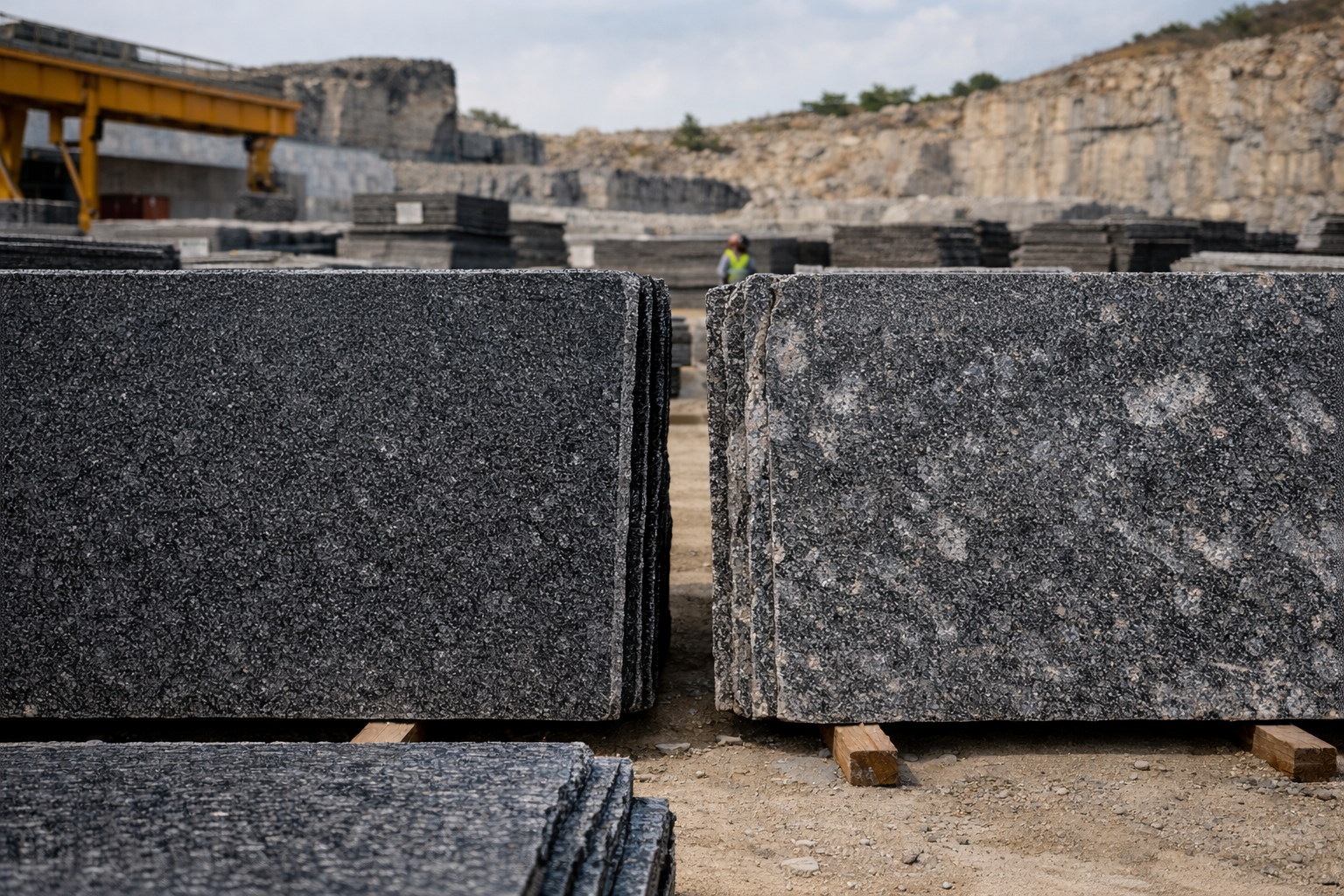
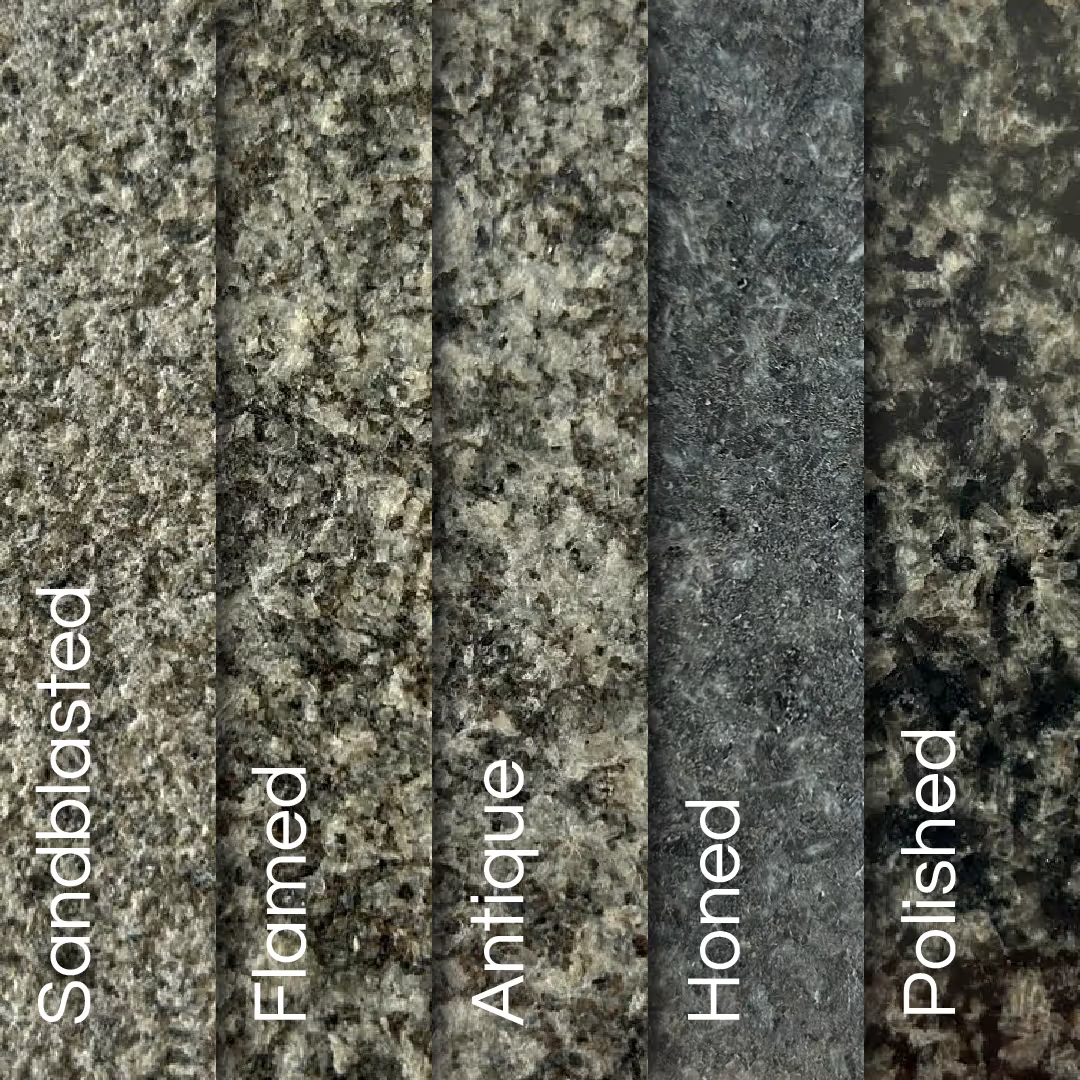
In the international natural stone trade, "Rustenburg granite" is used as a blanket term for the dark norite and gabbronorite extracted from the Bushveld Igneous Complex in South Africa's North West Province. But professionals who work with this material daily know that not all Rustenburg granite is the same. The two primary quarrying areas — K2 and Sonop — produce stone with distinctly different visual characteristics, mineral compositions, and performance properties.
For fabricators, distributors, architects, and export buyers, understanding these differences is not academic. It directly affects colour matching across a project, client expectations, material selection, and pricing. This article provides a quarry-level technical comparison to help you specify with confidence.
Geological Background
Both K2 and Sonop quarries extract stone from the Bushveld Igneous Complex, one of the largest layered igneous intrusions on Earth. The complex formed approximately 2.05 billion years ago when magma intruded into the Earth's crust and cooled slowly, allowing large mineral crystals to form. The result is a family of dark plutonic rocks classified as norite and gabbronorite.
While the geological origin is shared, the specific mineral ratios and crystal structures vary across the complex. The K2 and Sonop quarrying areas sit at different positions within the layered intrusion, resulting in measurable differences in mineral content and visual appearance.
K2 Rustenburg Granite
K2 granite takes its name from the K2 quarrying area near Rustenburg. It is characterised by:
Visual Characteristics
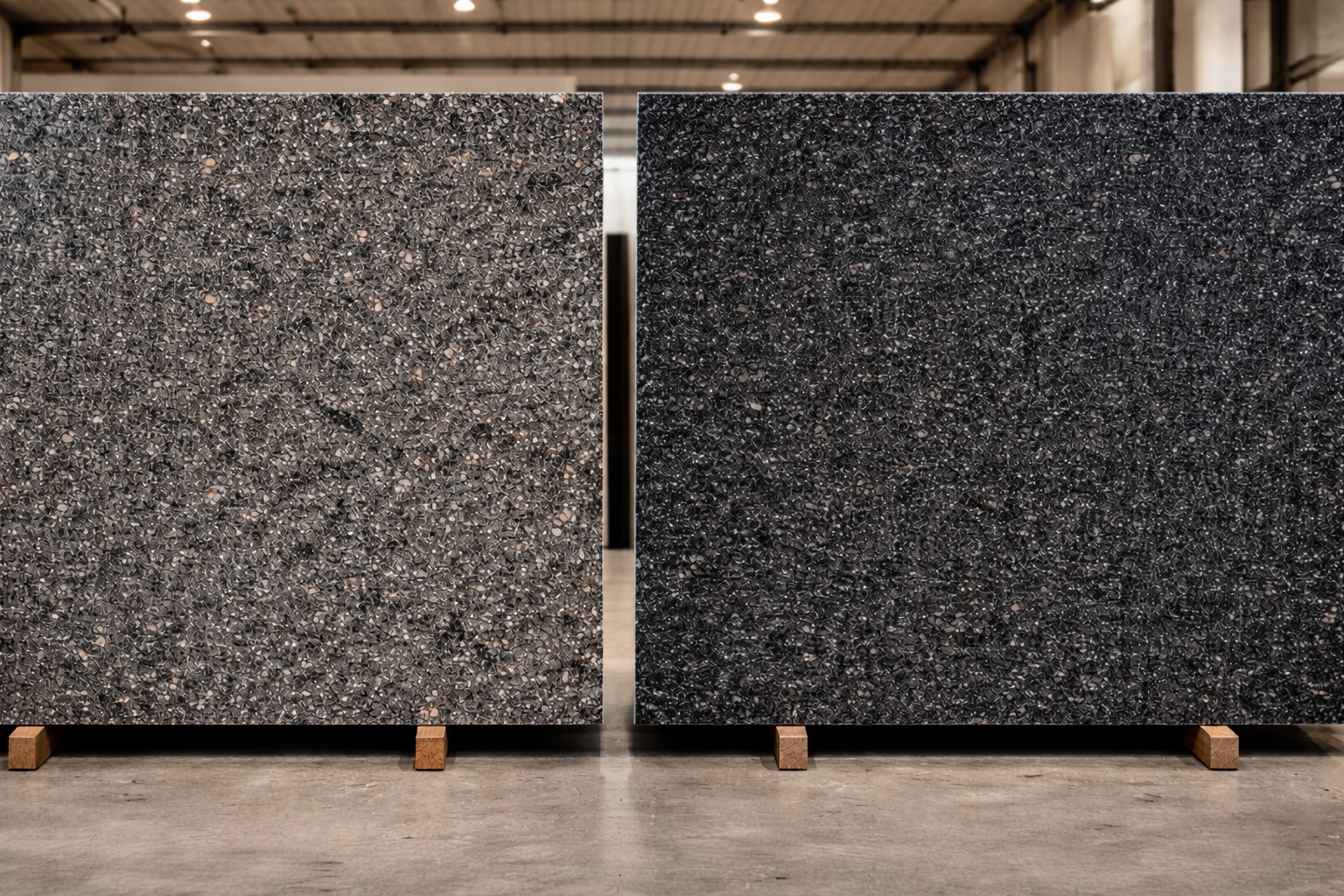
- Base colour: Dark charcoal grey with a slightly warmer undertone compared to Sonop
- Mineral flecks: Prominent silver-grey plagioclase feldspar crystals that give the stone its distinctive "salt and pepper" appearance
- Crystal size: Medium to coarse-grained, with visible mineral crystals typically 2-5 mm in diameter
- Overall impression: A warm, characterful dark stone with visible mineral depth and movement
Mineral Composition
K2 granite is technically a norite, composed primarily of plagioclase feldspar (labradorite), orthopyroxene (hypersthene), and minor amounts of clinopyroxene, olivine, and chromite. The higher proportion of visible plagioclase gives K2 its lighter, warmer character relative to Sonop.
Performance Properties
- Density: Approximately 2,900-3,000 kg/m³
- Compressive strength: 180-250 MPa
- Water absorption: 0.10-0.20%
- Mohs hardness: 6-7
Best Applications
K2 is widely specified for polished slabs, kitchen countertops, tombstone components, floor tiles, and interior wall cladding. Its warmer tone makes it particularly popular for residential applications and memorial products where visual warmth is valued.
Sonop Rustenburg Granite
Sonop granite is extracted from the Sonop quarrying area, also within the Rustenburg district. It presents a distinctly different character:
Visual Characteristics
- Base colour: Deeper, cooler charcoal to near-black, with a blue-grey undertone
- Mineral flecks: Finer, less prominent silver mineral crystals — the stone appears more uniform and darker overall
- Crystal size: Fine to medium-grained, with mineral crystals typically 1-3 mm in diameter
- Overall impression: A cooler, more uniform dark stone that approaches the appearance of premium international black granites
Mineral Composition
Sonop stone is classified as gabbronorite, with a higher proportion of pyroxene minerals (both orthopyroxene and clinopyroxene) relative to plagioclase feldspar. This higher dark-mineral content gives Sonop its deeper, cooler colour. Minor minerals include ilmenite, magnetite, and trace amounts of sulphide minerals.
Performance Properties
- Density: Approximately 2,950-3,050 kg/m³
- Compressive strength: 190-260 MPa
- Water absorption: 0.08-0.18%
- Mohs hardness: 6-7
Best Applications
Sonop is the preferred choice for export markets seeking a darker, more uniform product. It is widely used for polished slabs destined for European and African markets, commercial flooring in corporate environments, facade cladding on prestige buildings, and monument and memorial products where a deep, consistent black is desired.
Side-by-Side Comparison
The following table summarises the key differences between K2 and Sonop for specification purposes:
| Property | K2 | Sonop |
|---|---|---|
| Base colour | Warm charcoal grey | Cool charcoal to near-black |
| Undertone | Warm (brown-grey) | Cool (blue-grey) |
| Crystal visibility | Prominent, coarser | Subtle, finer |
| Overall uniformity | More variation and movement | More uniform and consistent |
| Darkness level | Medium-dark | Dark to very dark |
| Rock classification | Norite | Gabbronorite |
| Density | 2,900-3,000 kg/m³ | 2,950-3,050 kg/m³ |
| Water absorption | 0.10-0.20% | 0.08-0.18% |
Specification Guidance: Which Should You Choose?
The choice between K2 and Sonop depends on the project requirements and end-client expectations:
Choose K2 When:
- The project calls for a characterful dark stone with visible mineral movement
- Residential applications where warmth is valued over uniformity
- Budget considerations are a factor — K2 is generally more readily available in larger volumes
- The design intent embraces natural variation rather than uniformity
- Tombstone and memorial applications in the South African domestic market
Choose Sonop When:
- The project requires a deep, uniform dark stone approaching true black
- Export markets demand consistency across large orders (European buyers typically prefer Sonop)
- Commercial projects where colour matching across large floor areas or facades is critical
- The design intent requires a sleek, contemporary, minimal-variation aesthetic
- The client is comparing against international black granites (Zimbabwe Black, Absolute Black India) and wants a competitive South African alternative
Colour Matching and Batch Consistency
One of the most common issues in natural stone projects is colour variation between batches. Because natural stone is a geological product, some variation is inherent and expected. However, the degree of variation differs between K2 and Sonop:
- K2 shows more slab-to-slab variation due to its coarser crystal structure. On large projects, it is essential to order sufficient material from a single production batch and to lay out slabs before installation to ensure an acceptable visual flow.
- Sonop offers better batch-to-batch consistency due to its finer, more uniform mineral distribution. This makes it easier to match material across orders and phases of a multi-stage project.
At Afrika National Granite, we recommend that fabricators and project buyers inspect slabs in person at our facility for any project where colour consistency is critical. Our team can assist with batch selection and quality grading to match your specific requirements.
Pricing Considerations
Both K2 and Sonop are competitively priced as South African granites, significantly below the cost of imported alternatives like Zimbabwe Black or Indian Absolute Black. Sonop generally commands a modest premium over K2 due to its deeper colour and greater demand in export markets. However, both materials offer exceptional value when sourced directly from a quarry owner-manufacturer like ANG, eliminating the markups associated with multi-tier distribution chains.
Visit Our Facility
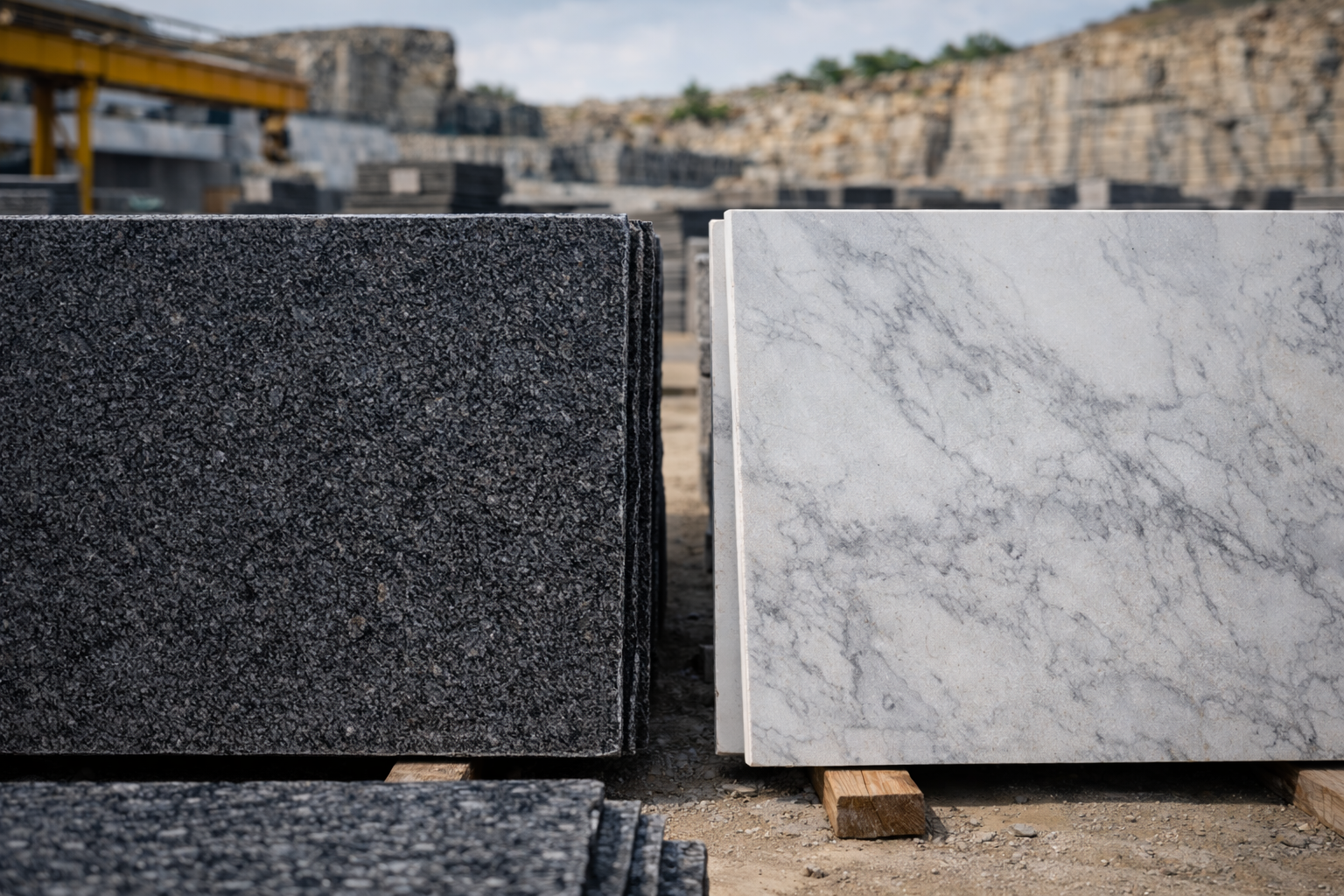
The difference between K2 and Sonop is best understood by seeing the materials side by side. Visit Afrika National Granite at 8 Dekenah Road, Alrode, Alberton to compare slabs from both quarry sources, discuss your project specifications with our technical team, and receive competitive pricing for your requirements. Whether you need polished slabs, cut-to-size tiles, or custom products, we manufacture directly from our own quarries for quality you can verify at source.