.avif)
Why South African Granite?
South Africa is one of the world's leading producers of premium natural granite, with the Bushveld Igneous Complex in the North West Province yielding some of the most sought-after dark granite varieties on the global market. Rustenburg granite — traded internationally as Nero Impala, Impala Black, or African Grey — is specified for projects across Europe, Africa, and beyond due to its exceptional hardness, consistent colour, and proven durability in both interior and exterior applications.
For international distributors, fabricators, and project contractors, sourcing directly from a South African quarry owner and manufacturer offers significant advantages over buying through intermediaries or competing with Chinese and Indian suppliers. This guide covers what you need to know to import South African granite efficiently.
South African Granite Varieties Available for Export
Rustenburg Granite (Nero Impala)
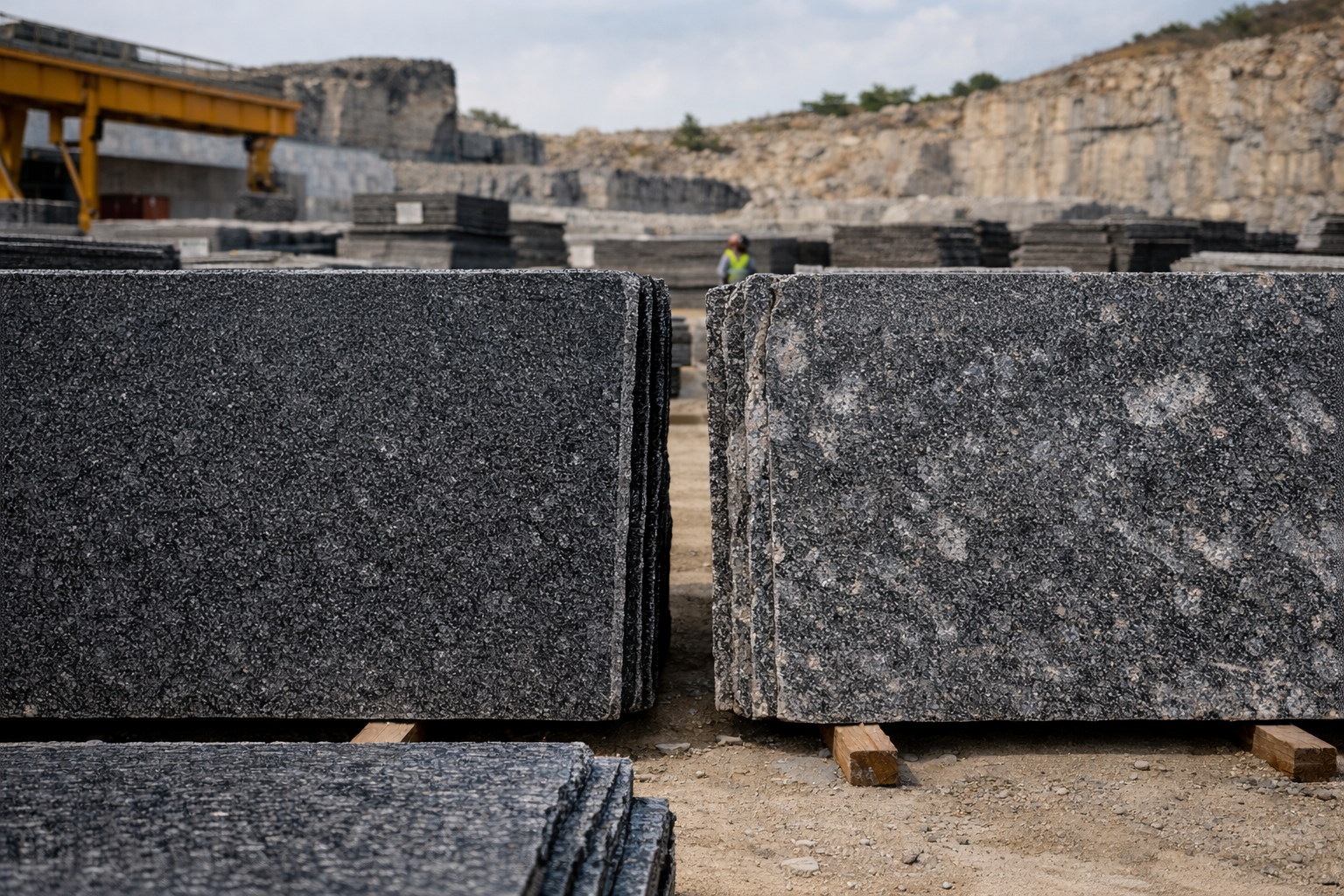
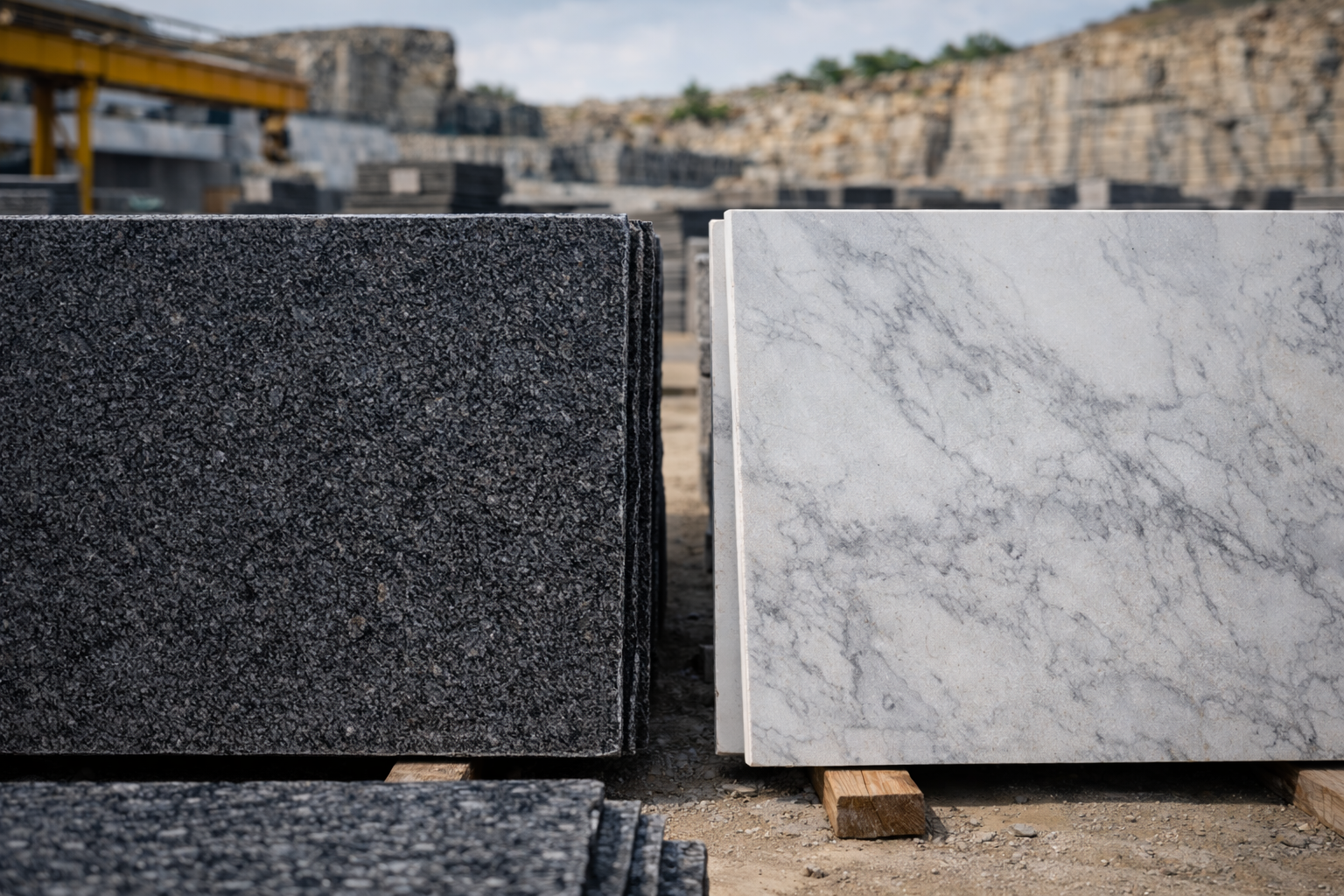
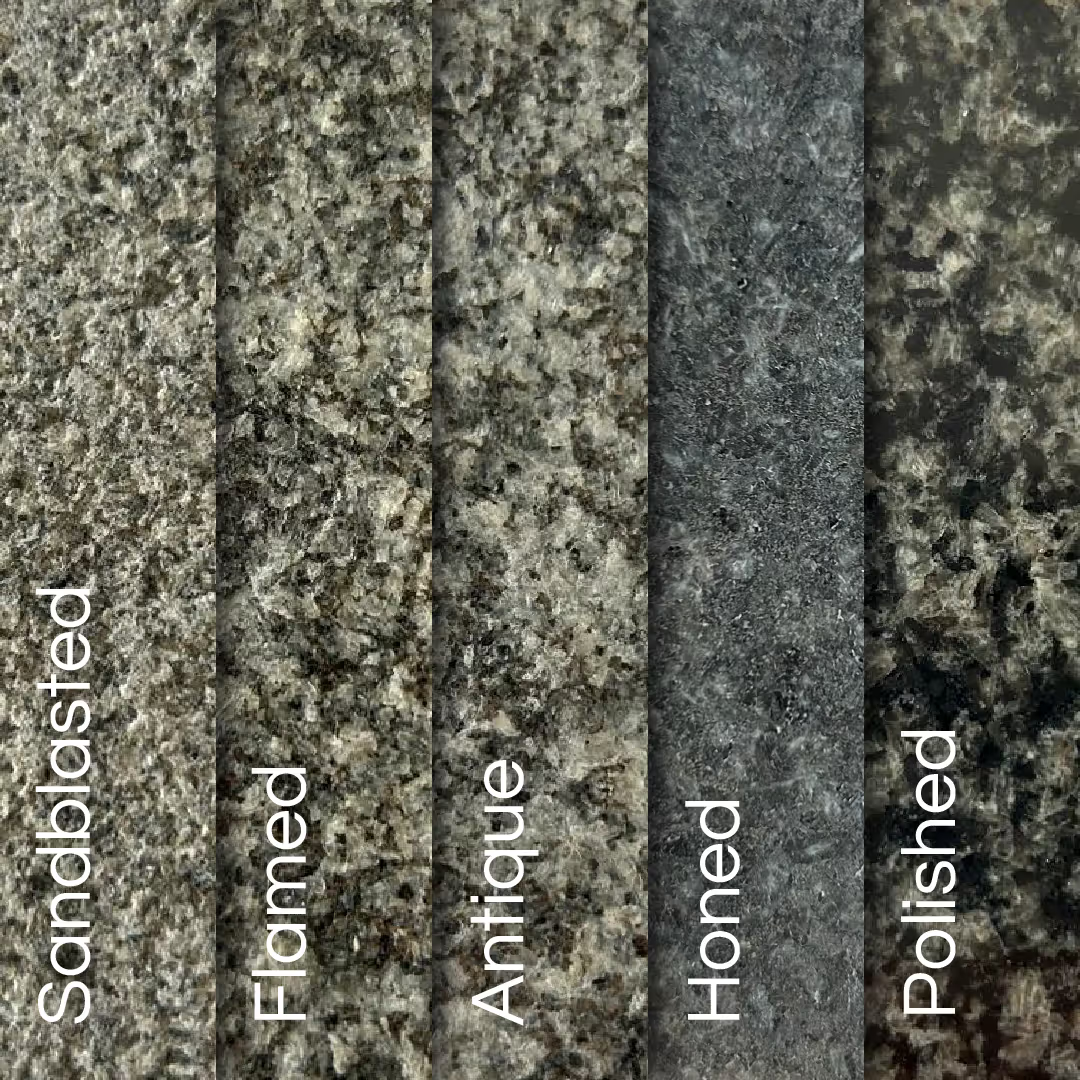
Rustenburg granite is South Africa's flagship natural stone export. It is a norite (a type of gabbro, geologically distinct from true granite but traded commercially as granite) with a dark charcoal-to-black base colour and fine silver-grey mineral flecks. It is the standard choice for interior countertops, exterior paving, memorial applications, and commercial cladding worldwide. Rustenburg granite is available in polished, honed, flamed, brushed, bush-hammered, and sandblasted finishes.
Belfast Black
Quarried near the town of Belfast in Mpumalanga, this granite is darker and more uniform than Rustenburg, with fewer visible mineral flecks. It is popular in the European market for high-end countertops and memorial applications.
African Red and Multicolour Varieties
South Africa also produces distinctive red and multicolour granite varieties that have no equivalent from Chinese or Indian quarries. These are niche products but can command premium pricing in the right markets.
Quality Grading: What Export Buyers Must Understand
South African granite manufacturers grade their production into quality tiers. For export orders, understanding these grades is critical because they directly affect your end-product quality and your reputation with your own clients.
First Choice (Export Grade)
First choice slabs are the standard for all export orders and meet the highest quality criteria. They feature consistent colour across the full slab face with no banding or colour shifts, even mineral distribution without clustering, no structural defects (cracks, fissures, soft spots), uniform thickness within ±1mm tolerance, and clean, straight edges. International buyers should insist on first choice material. If a supplier offers "export quality" at unusually low prices, request inspection photographs or visit the facility before committing to a large order.
Second Choice (Regional Grade)
Second choice slabs have minor cosmetic variations that make them unsuitable for the demanding export market but perfectly acceptable for domestic and regional African markets. For international buyers targeting the most competitive price point, second choice may be acceptable for specific applications (exterior paving, utility surfaces) where minor colour variations are tolerable. Discuss your specific requirements with your supplier.
Logistics and Shipping
Container Loading
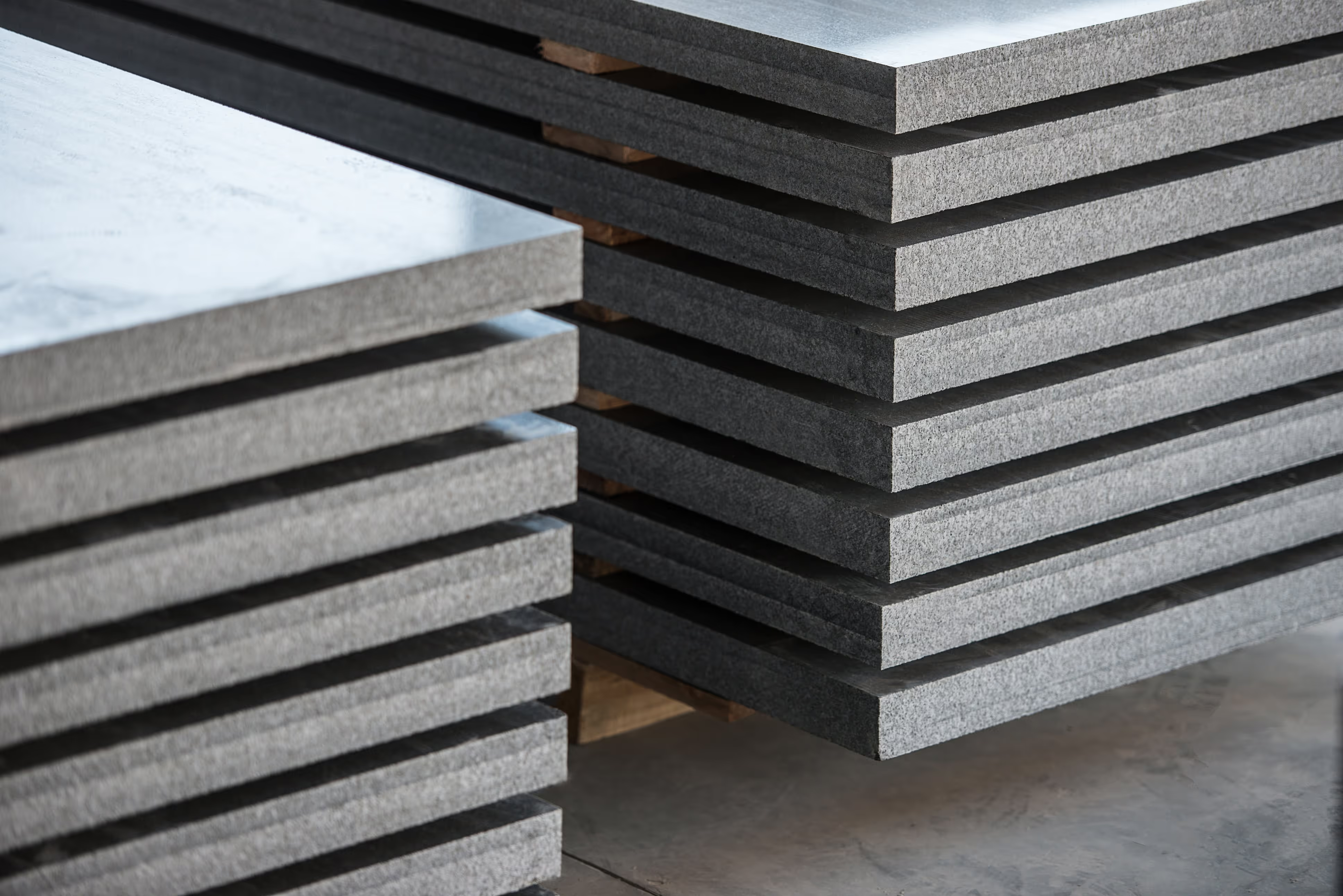
Granite slabs are typically shipped in 20-foot or 40-foot open-top or flat-rack containers. Standard loading configurations depend on slab dimensions and thickness. A 20-foot container typically accommodates 18–22 tonnes of granite slabs depending on slab size. A 40-foot container accommodates 24–28 tonnes. Slabs are loaded vertically in A-frame racks or horizontally on timber bearers, depending on slab dimensions and the buyer's preference. Proper packing is critical — inadequate dunnage and bracing during transit is the primary cause of breakage in granite shipments.
Port of Export
Most South African granite exports ship from the Port of Durban, the largest container port in sub-Saharan Africa. Durban offers regular sailings to European ports (Rotterdam, Hamburg, Felixstowe), East African ports (Mombasa, Dar es Salaam), and Southern African destinations (Maputo, Beira). Transit times vary from 3–5 days for regional African destinations to 18–25 days for European destinations.
Export Documentation
Standard export documentation for South African granite includes a commercial invoice and packing list, bill of lading, certificate of origin (for preferential tariff access under trade agreements), phytosanitary certificate (if timber packing materials are used), and quality inspection certificate (if requested by the buyer). Afrika National Granite handles all export documentation and can work with your preferred freight forwarder or arrange freight on your behalf.
Pricing Considerations for International Orders
Why Direct-from-Quarry Pricing Matters
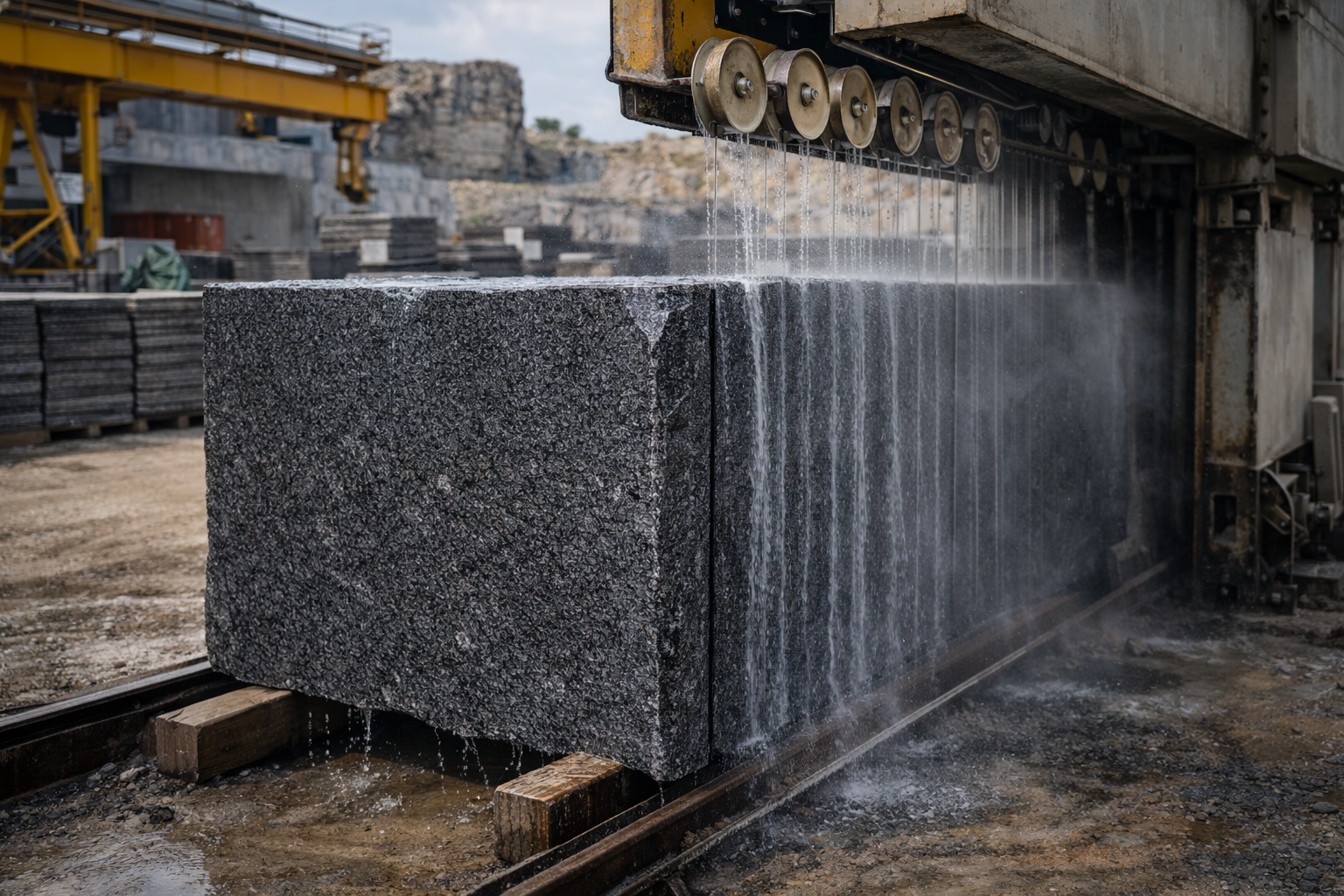
The international granite market includes multiple layers of intermediaries — quarry owners sell to manufacturers, manufacturers sell to exporters, exporters sell to importers, importers sell to distributors, distributors sell to fabricators. Each layer adds margin. When you buy from a vertically integrated producer like Afrika National Granite — who owns the quarry, manufactures the slabs, and handles export directly — you eliminate every intermediary margin between the quarry face and your warehouse.
Pricing Structure
International orders are typically quoted on an FOB (Free On Board) or CIF (Cost, Insurance, Freight) basis. FOB pricing means the price includes all costs up to loading the container at the port of export. You arrange and pay for ocean freight and insurance. CIF pricing includes ocean freight and insurance to your destination port. You handle customs clearance and inland delivery. For first-time buyers, CIF pricing provides more cost certainty. Established importers with freight forwarding relationships typically prefer FOB pricing for greater control over logistics costs.
Minimum Order Quantities
Export orders typically require a minimum of one full container load. This is not an arbitrary minimum — it reflects the economics of international shipping, where the per-unit freight cost of a partial container is prohibitively expensive. For buyers who cannot commit to full container loads, sourcing through a local distributor who imports in volume may be more economical.
Competing with Chinese and Indian Granite
International buyers often compare South African granite pricing against Chinese and Indian alternatives. Here is a realistic comparison to help you make informed sourcing decisions.
Where South African Granite Wins
South African Rustenburg granite has no direct equivalent from China or India. The specific mineral composition and colour profile of Rustenburg (Nero Impala) cannot be replicated — it is a product of a specific geological formation. For projects specifying Rustenburg granite by name, there is no substitute. Additionally, South African granite benefits from established quality grading systems with transparent standards, shorter shipping times to European and African markets compared to Asian suppliers, no risk of substitution or bait-and-switch (a documented problem with some Asian suppliers), and direct quarry-to-buyer relationships that ensure accountability.
Where China and India Compete
For generic dark granite applications where the specific variety is not critical, Chinese and Indian suppliers can offer lower per-square-metre pricing on standard products, faster production for large standardised orders, and a broader variety of colour options from a single source country. If your market does not specifically demand South African granite and price is the primary factor, Asian suppliers may be competitive for certain products.
Why International Buyers Choose ANG
Afrika National Granite currently exports to Botswana, Mozambique, Poland, Hungary, Montenegro, Slovakia, and Croatia, and is actively expanding into Albania, Czech Republic, Serbia, Germany, the United Kingdom, Bulgaria, Lithuania, Kenya, Ghana, Cameroon, Nigeria, Ethiopia, Zimbabwe, Malawi, and Uganda.
International buyers choose us because we are a vertically integrated quarry owner and manufacturer offering true direct-from-source pricing. We have established export processes with full documentation handling. We provide first choice export-grade material with consistent quality control. We can supply slabs, cut-to-size components, tiles, pavers, cobbles, and specialty products from a single source. We have experience with both European and African market requirements and standards.
For export enquiries, contact our team to discuss your requirements, request samples, or arrange a factory visit at 8 Dekenah Road, Alrode, Alberton, South Africa.