Why Granite Tiles Remain the Professional's First Choice
In commercial and high-end residential projects, the choice between natural granite tiles and ceramic alternatives is rarely just about aesthetics. It is a decision that affects structural performance, maintenance costs, and long-term asset value. For architects, fabricators, and contractors specifying floor and wall finishes, understanding the full spectrum of granite tile options — and how they compare to ceramics — is essential to delivering projects that perform for decades.
Afrika National Granite manufactures granite tiles directly from our own Rustenburg quarries, giving specifiers direct access to consistent material quality, custom sizing, and competitive pricing that eliminates distributor markups.
Standard Granite Tile Formats
Granite tiles are manufactured in a range of standard formats to suit different applications. The most commonly specified sizes in the South African and export markets include:
- 300 x 300 mm (12" x 12") — The most popular format for residential flooring and wall cladding. Versatile, easy to handle, and suitable for both interior and exterior applications.
- 400 x 400 mm (16" x 16") — Increasingly specified for commercial lobbies and retail spaces where a larger format reduces grout lines and creates a more seamless appearance.
- 600 x 300 mm (24" x 12") — A rectangular format popular for wall cladding, feature walls, and contemporary floor layouts. Creates a modern linear aesthetic.
- 600 x 600 mm (24" x 24") — Large-format tiles for commercial flooring, airport terminals, and corporate lobbies. Requires skilled installation but delivers maximum visual impact.
- Custom sizes — ANG's cut-to-size facility can produce tiles in non-standard dimensions for bespoke architectural projects.
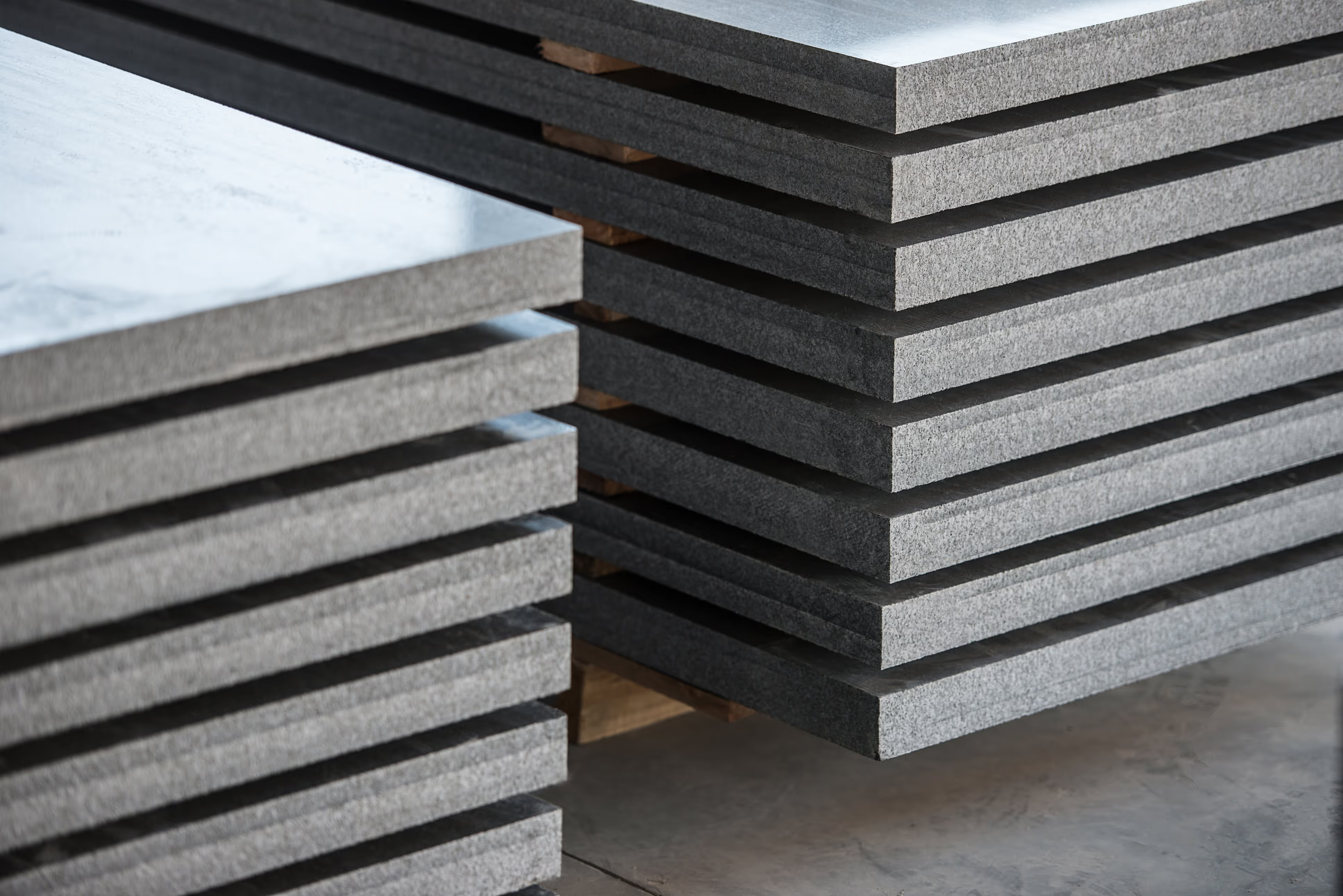
Tile thickness typically ranges from 10 mm for wall applications to 20 mm for heavy-traffic commercial floors. Thicker tiles (30 mm) are available for external paving where additional structural strength is required.
Surface Finishes for Granite Tiles
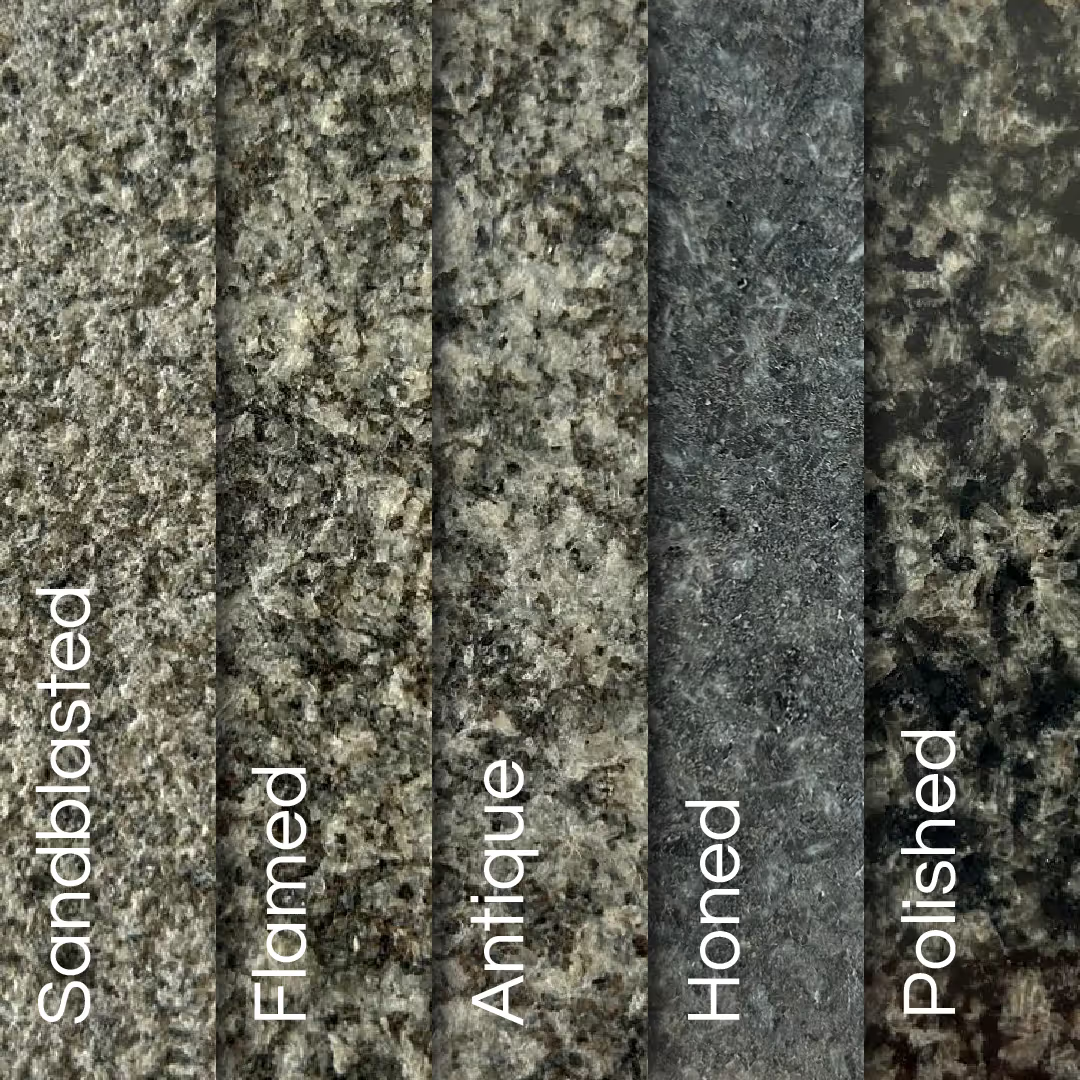
The surface finish transforms the character of granite and determines its suitability for specific applications. ANG offers the following finish options across our tile range:
Polished
A mirror-like reflective finish that brings out the full depth of colour and mineral character in the stone. Polished granite tiles are the standard choice for interior floors, reception areas, and feature walls. The high-gloss surface is easy to clean but can be slippery when wet, so it is primarily specified for interior use.
Honed
A smooth, matte finish with no reflective sheen. Honed granite offers a contemporary, understated aesthetic that is increasingly popular in modern architectural projects. It provides better slip resistance than polished stone while maintaining a refined appearance. Ideal for bathrooms, kitchens, and transitional indoor-outdoor spaces.
Flamed (Thermal)
Created by exposing the granite surface to high-temperature flame, this finish produces a rough, textured surface with excellent slip resistance. Flamed granite tiles are the standard specification for outdoor paving, pool surrounds, and any area exposed to water. The process slightly lightens the stone colour.
Brushed (Antiqued)
A textured finish that combines the slip resistance of flamed stone with a softer, more natural appearance. Brushed granite is achieved by mechanical processing that creates a lightly worn surface. Popular for heritage projects, garden paths, and rustic-contemporary interiors.
Sandblasted
A uniformly textured finish created by high-pressure sand treatment. Provides consistent slip resistance and a neutral matte appearance. Commonly specified for commercial exterior paving and public spaces where uniform traction is required.
Granite Tiles vs Ceramic: An Honest Comparison
The ceramic tile industry has invested heavily in products that mimic the appearance of natural stone. While modern porcelain and ceramic tiles can be visually convincing, the performance gap between natural granite and manufactured alternatives remains significant in several critical areas.
Durability and Hardness
Granite rates 6-7 on the Mohs hardness scale, making it one of the hardest natural building materials available. This translates to exceptional scratch resistance, abrasion resistance, and longevity under heavy traffic. Ceramic tiles, even premium porcelain, rate 5-6 on the same scale. In high-traffic commercial environments — hotel lobbies, retail stores, office buildings — granite floors routinely last 50-100 years with minimal maintenance. Ceramic floors in equivalent settings typically require replacement within 15-25 years as the surface glaze wears through.
Impact Resistance
A 20 mm granite tile has significantly greater impact resistance than an equivalent ceramic tile. Dropped objects, heavy furniture, and point loads that would crack or chip ceramic tiles are absorbed by granite without damage. This is particularly relevant in commercial kitchens, industrial facilities, and any environment where accidental impacts are likely.
Colour Consistency Through Depth
Natural granite is consistent through its entire thickness — if the surface is scratched or chipped, the colour and pattern continue through the full depth of the tile. Ceramic tiles carry a printed pattern layer of typically 1-3 mm over a clay body. Any chip or deep scratch exposes the pale clay beneath, creating visible damage that cannot be repaired without replacing the tile.
Thermal Performance
Granite has superior thermal mass compared to ceramic, meaning it absorbs and slowly releases heat. This property makes granite tiles effective in conjunction with underfloor heating systems, as the stone retains warmth longer than ceramic alternatives. In hot climates, granite floors remain naturally cool underfoot — a significant comfort advantage in South African residential and commercial buildings.
UV and Weather Resistance
Natural granite is completely UV-stable. The colour will not fade, yellow, or change with sun exposure over any timeframe. Ceramic tiles with printed surfaces can experience colour degradation under prolonged UV exposure, particularly in exterior applications or interior spaces with significant natural light. For outdoor applications — patios, pool surrounds, driveways — granite's UV resistance makes it the clearly superior choice.
Value Retention
Properties with natural stone finishes consistently command higher valuations than those with ceramic alternatives. Estate agents and property valuers recognise granite as a premium material that signals quality construction. For property developers, the specification of granite tiles can increase the perceived and actual value of a development.
Where Ceramic Has the Advantage
Transparency matters in professional specification. Ceramic tiles do offer advantages in certain areas:
- Lower upfront cost — Ceramic tiles are typically cheaper per square metre at point of purchase, though the lifecycle cost calculation often favours granite.
- Lighter weight — Ceramic tiles are significantly lighter than granite, which can be relevant for wall cladding on lightweight structures or upper-floor renovations where load capacity is limited.
- Design variety — Ceramic manufacturers can print virtually any pattern, colour, or texture onto tiles, offering a design range that natural stone cannot match. If a project requires a specific colour that does not exist in nature, ceramic is the practical choice.
Specification Considerations for Professionals
When specifying granite tiles for a project, several factors should be considered beyond format and finish:
- Calibration — Ensure tiles are calibrated (ground to uniform thickness) for consistent installation. ANG supplies calibrated tiles as standard.
- Sealing — Polished and honed granite tiles for interior use benefit from a penetrating sealer to prevent staining. Flamed and sandblasted tiles for exterior use typically do not require sealing.
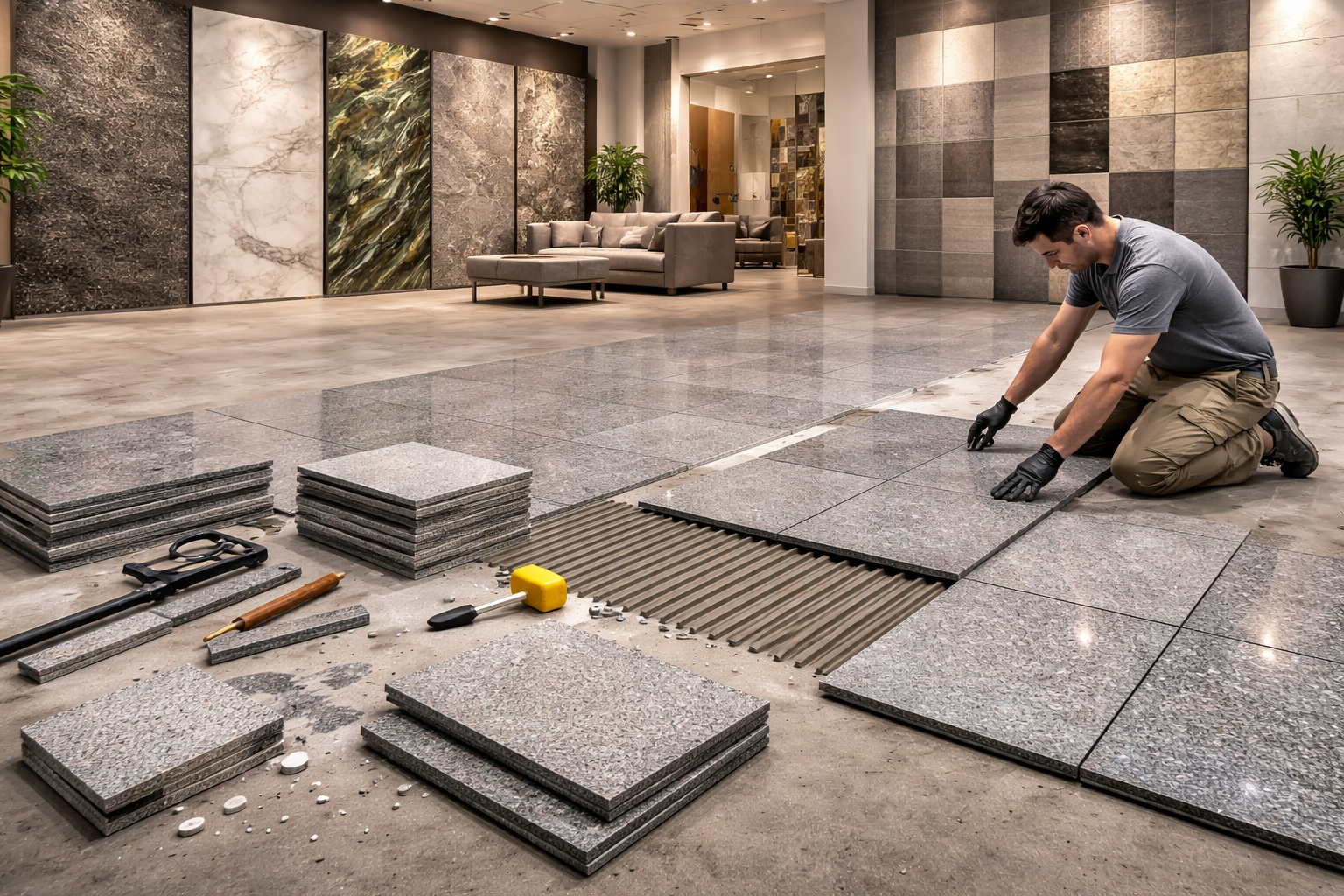
- Adhesive selection — Granite tiles require a flexible, polymer-modified adhesive (not standard cement-based tile adhesive). The additional adhesive cost is minimal but essential for a lasting installation.
- Movement joints — Natural stone installations require movement joints at perimeters and at intervals across large floor areas. Follow SANS or BS standards for joint spacing.
- Grout selection — Use cementitious or epoxy grout appropriate to the application. Epoxy grout is recommended for commercial kitchens, food processing areas, and wet environments.
ANG's Granite Tile Offering
As a vertically integrated quarry owner and manufacturer, Afrika National Granite offers a complete granite tile solution:
- Rustenburg granite tiles in all standard formats and finishes — our core product, manufactured from our own quarries
- Exotic and imported stone tiles — Rain Forest Green, Patagonia, Carrara Black, and other premium materials available in tile formats
- Custom cut-to-size — Non-standard dimensions for bespoke architectural projects
- Volume pricing — Direct-from-quarry pricing for distributors, fabricators, and project buyers
- Export quality — First-choice graded tiles for international markets, with logistics support for container shipments
Visit Our Factory
The best way to evaluate granite tile options for your project is to see and feel the material in person. Visit our facility at 8 Dekenah Road, Alrode, Alberton to view our full range of tile formats and finishes, discuss your project requirements with our technical team, and receive a competitive quotation. Contact Afrika National Granite today to discuss your granite tile specification.