Granite Staircases: Where Engineering Meets Aesthetics
A granite staircase is one of the most visually striking architectural elements in any building. From sweeping commercial entrance stairs to intimate residential staircases, natural granite delivers a combination of structural performance, slip resistance, and visual impact that no other material can match. However, staircases are also safety-critical elements — they are one of the most common locations for slips, trips, and falls in buildings. Proper specification of granite step treads requires careful attention to surface finish, nosing detail, dimensional consistency, and regulatory compliance.
This guide provides architects, contractors, and fabricators with the technical knowledge to specify granite staircases that are both beautiful and safe.
Dimensional Standards for Granite Steps
Consistent dimensions across all steps in a flight are critical for safety. Human gait adjusts to the first few steps, and any variation in going or rise creates a trip hazard. Key dimensional standards:
Rise and Going
- Rise (riser height): 150-180 mm is the standard range. South African building regulations (SANS 10400-M) specify maximum 200 mm for residential and 180 mm for commercial buildings. Consistent rise across all steps in a flight is mandatory.
- Going (tread depth): 250-300 mm minimum. A deeper going provides a more comfortable stair and better foot placement on the tread surface. Commercial stairs typically specify 280-300 mm.
- Nosing overhang: 20-30 mm projection beyond the riser face. The nosing defines the visible edge of each step and provides additional tread depth.
Tread Width
- Residential: 900 mm minimum clear width between handrails (SANS 10400-M)
- Commercial: 1,000-1,200 mm minimum depending on occupancy and fire escape requirements
- Monumental/entrance stairs: 1,500-3,000 mm or wider for prestige commercial and public building entrances
Tread Thickness
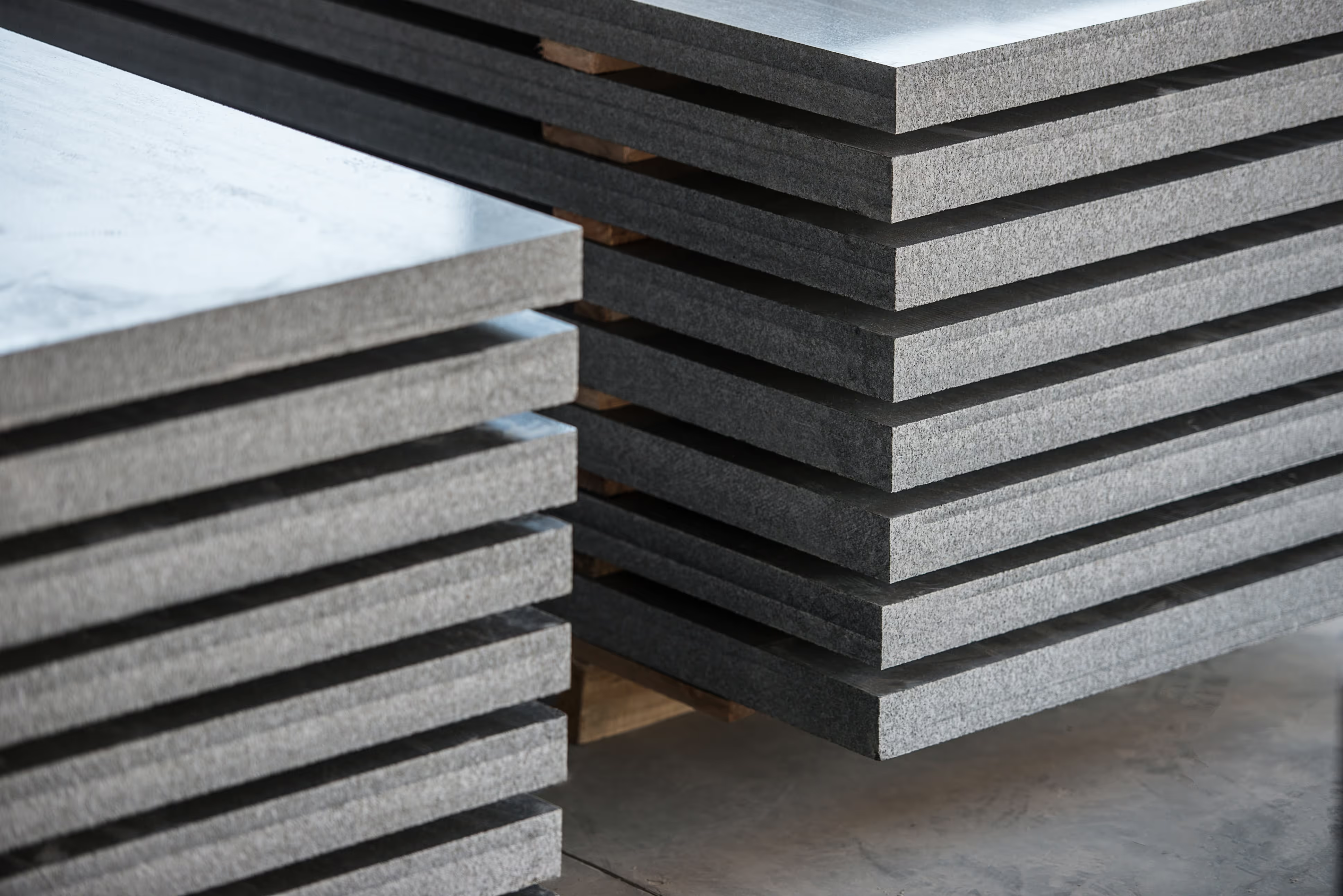
- 30 mm — Standard for treads supported on a concrete or steel substrate along their full length
- 40-50 mm — For cantilevered treads or those with unsupported spans exceeding 400 mm
- 80-150 mm — Solid monolithic treads for open-riser staircases where the granite tread is the structural element
Slip Resistance: The Critical Safety Specification
Slip resistance is the single most important safety consideration for granite staircases. A polished granite surface, while beautiful, can be dangerously slippery on a staircase, particularly in wet conditions or under foot traffic from wet shoes.
Slip Resistance Ratings
Slip resistance is measured using the pendulum test (BS 7976 / SANS method) or the ramp test (DIN 51130). For staircases:
- Interior dry staircases: Minimum PTV (Pendulum Test Value) of 36. Honed granite typically achieves this.
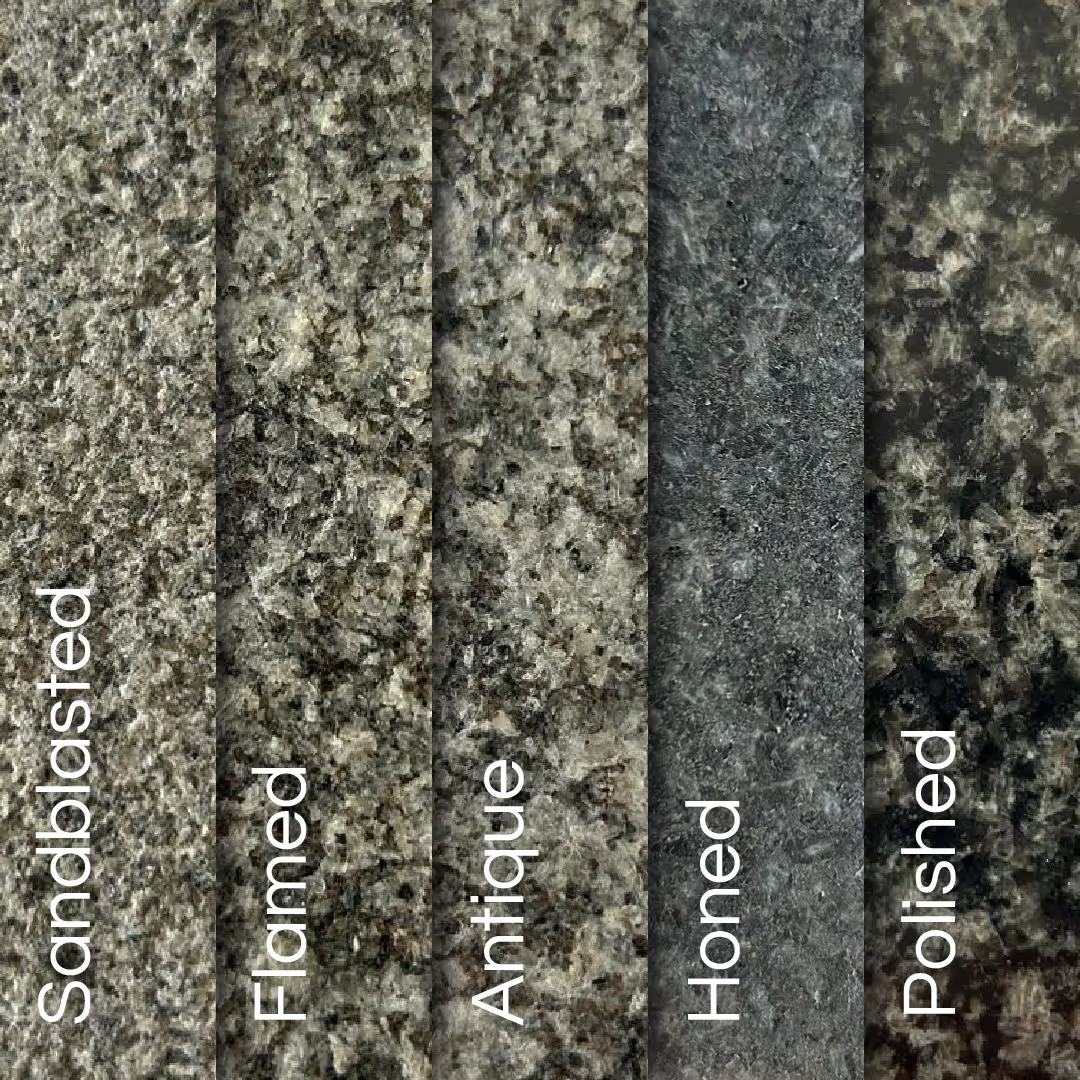
- Interior staircases in wet-prone areas: Minimum PTV 45. Flamed or bush-hammered finishes required.
- Exterior staircases: Minimum PTV 45, preferably 55+. Flamed, bush-hammered, or sandblasted finishes are mandatory.
- Ramp test equivalent: R10 minimum for interior level surfaces, R11 for interior ramps and stairs, R12-R13 for exterior stairs and ramps.
Achieving Slip Resistance on Granite Treads
Several approaches ensure adequate slip resistance on granite stair treads:
- Full tread in flamed finish — The entire tread surface is flamed, providing consistent slip resistance across the full going. This is the most conservative and safest approach.
- Flamed nosing strip — A 50-80 mm wide flamed strip at the leading edge of an otherwise honed or polished tread. This provides slip resistance where it matters most (the nosing) while allowing a smoother finish on the rest of the tread. A common specification for interior commercial stairs.
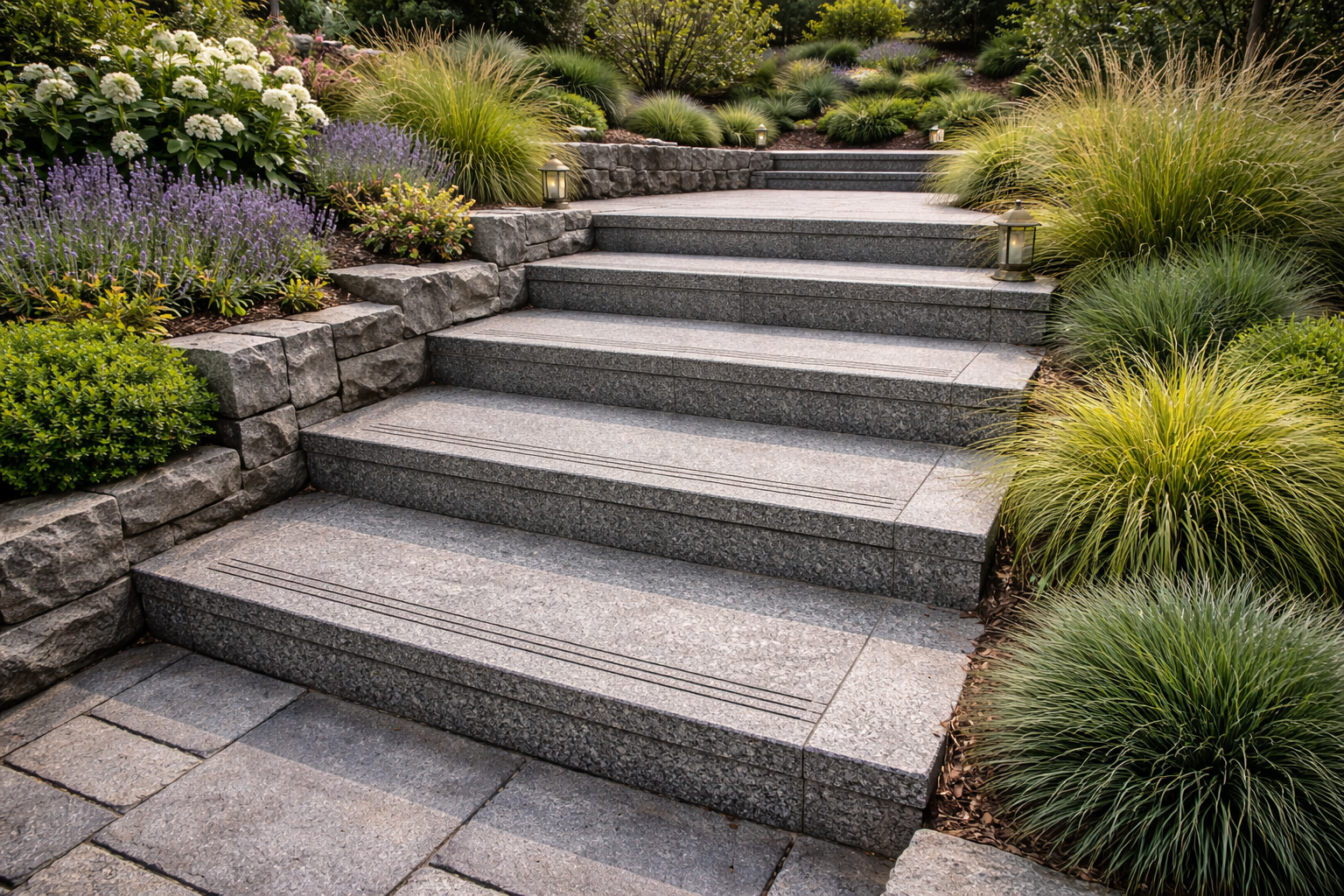
- Grooved nosing — Machine-cut grooves (typically 5-8 mm wide, 3-5 mm deep, at 10-15 mm centres) in the tread surface at the nosing edge. Grooves provide mechanical grip independent of the surface finish and are a reliable long-term slip resistance solution.
- Carborundum insert strips — Recessed metal or composite strips with abrasive inserts, set into the granite tread at the nosing. Provide the highest level of slip resistance and are commonly specified for public buildings, hospitals, and transit stations.
Nosing Design and Safety
The nosing — the leading edge of each tread — is the most critical detail for both safety and aesthetics:
Nosing Profiles
- Pencil round — A small radius (3-5 mm) on the top and bottom edges of the nosing. The standard detail for most commercial and residential stairs. Provides a clean appearance while removing sharp edges.
- Bullnose — A full semicircular profile on the front edge. Traditional and visually soft. Common on residential stairs and heritage buildings.
- Square with chamfer — A crisp 90-degree edge with a small 2-3 mm chamfer to remove the sharp arris. Contemporary and architectural. Requires careful handling during installation.
- Anti-slip groove at nosing — A recessed groove (8-10 mm from the front edge) provides a visual and tactile warning of the step edge.
Visual Contrast at Nosing
Building accessibility standards require that the nosing of each step is visually distinguishable from the tread and riser. For granite staircases, this can be achieved through:
- Finish contrast — Flamed nosing strip on a polished or honed tread creates a visible textural contrast.
- Colour contrast — A lighter granite strip set into the tread at the nosing (for example, a light grey granite strip in a dark Rustenburg tread).
- Metal insert — A brass, stainless steel, or aluminium strip recessed into the tread at the nosing edge.
Riser Options
The riser — the vertical face between treads — offers an opportunity for design contrast:
- Polished riser with flamed tread — The most popular combination. The polished riser showcases the stone's colour depth while the flamed tread provides slip resistance. The contrast between reflective and matte surfaces creates an elegant visual rhythm.
- Matching finish — Both tread and riser in the same finish (honed, flamed) for a uniform, minimalist appearance.
- Open riser — No riser panel; the tread floats on a structural support (typically steel stringers or a cantilevered concrete structure). Creates a light, contemporary staircase. Requires thicker treads (40-150 mm depending on span).
Structural Considerations
Support Systems
- Concrete stringer staircase — The most common system. A reinforced concrete staircase structure provides full support for the granite treads. Treads are typically 30 mm thick, adhesive-fixed to the concrete with a polymer-modified flexible adhesive.
- Steel stringer staircase — Steel stringers (side beams) support granite treads either from below or from the sides. Treads are typically 40-50 mm thick and mechanically fixed to the steel structure.
- Cantilevered treads — Granite treads project from a wall with no visible support beneath. Requires minimum 50 mm thickness and steel reinforcement within or beneath the granite. Achieves spans of 400-800 mm depending on tread thickness and stone type.
Weight Calculations
Granite weighs approximately 2,700-3,000 kg/m³. For staircase design:
- A standard 30 mm tread at 300 mm going x 1,200 mm wide weighs approximately 29 kg
- A 50 mm monolithic tread at the same dimensions weighs approximately 49 kg
- Factor in riser weight if applicable
- Ensure the supporting structure is designed for the combined dead load of all granite elements plus live loads
Installation Best Practices
- Template on-site — Template each tread position individually. Concrete staircase structures rarely achieve perfect dimensional consistency.
- Level each tread — Use self-levelling adhesive or mortar bed to ensure each tread is perfectly level and at the correct height.
- Consistent joints — Maintain uniform joint widths between treads and risers for a professional finish.
- Edge protection during construction — Granite nosings are vulnerable to chipping during the construction phase. Protect installed treads with timber edge guards until the project is complete.
- Sealing — Apply a penetrating sealer to polished and honed treads. Flamed treads generally do not require sealing.
ANG's Staircase Products
Afrika National Granite manufactures staircase components from our own Rustenburg quarries:
- Step treads in all standard dimensions and custom sizes
- Riser panels — polished, honed, or matching tread finish
- Nosing profiles — pencil round, bullnose, square, and custom profiles
- Landing tiles — matching treads for staircase landings
- Skirting — matching granite skirting for staircase walls
Get a Quotation
Visit our facility at 8 Dekenah Road, Alrode, Alberton to discuss your staircase specification, view tread samples and nosing profiles, and receive a competitive quotation. Afrika National Granite supplies staircase components for residential, commercial, and monumental projects across South Africa and for export. Contact us today.