Why Granite Remains the Gold Standard for Kitchen Countertops
Despite the growth of engineered stone and porcelain slab alternatives, natural granite continues to dominate the premium kitchen countertop market globally. The reasons are straightforward: granite offers unmatched durability, heat resistance, unique natural beauty, and a long-term return on investment that manufactured alternatives cannot replicate.
For kitchen companies, fabricators, and interior designers specifying countertops in South Africa and internationally, understanding the full range of granite options, edge profiles, and installation requirements is essential to delivering projects that satisfy discerning clients. This guide provides the technical and practical knowledge you need to specify and install granite countertops with confidence.
Choosing the Right Granite for Kitchen Countertops
Not all granite is equally suited to kitchen applications. The ideal kitchen countertop granite combines aesthetic appeal with practical performance. Key selection criteria include:
Colour and Pattern
Kitchen countertop colour should complement the cabinetry, flooring, and overall design scheme. The most popular choices in the South African market include:
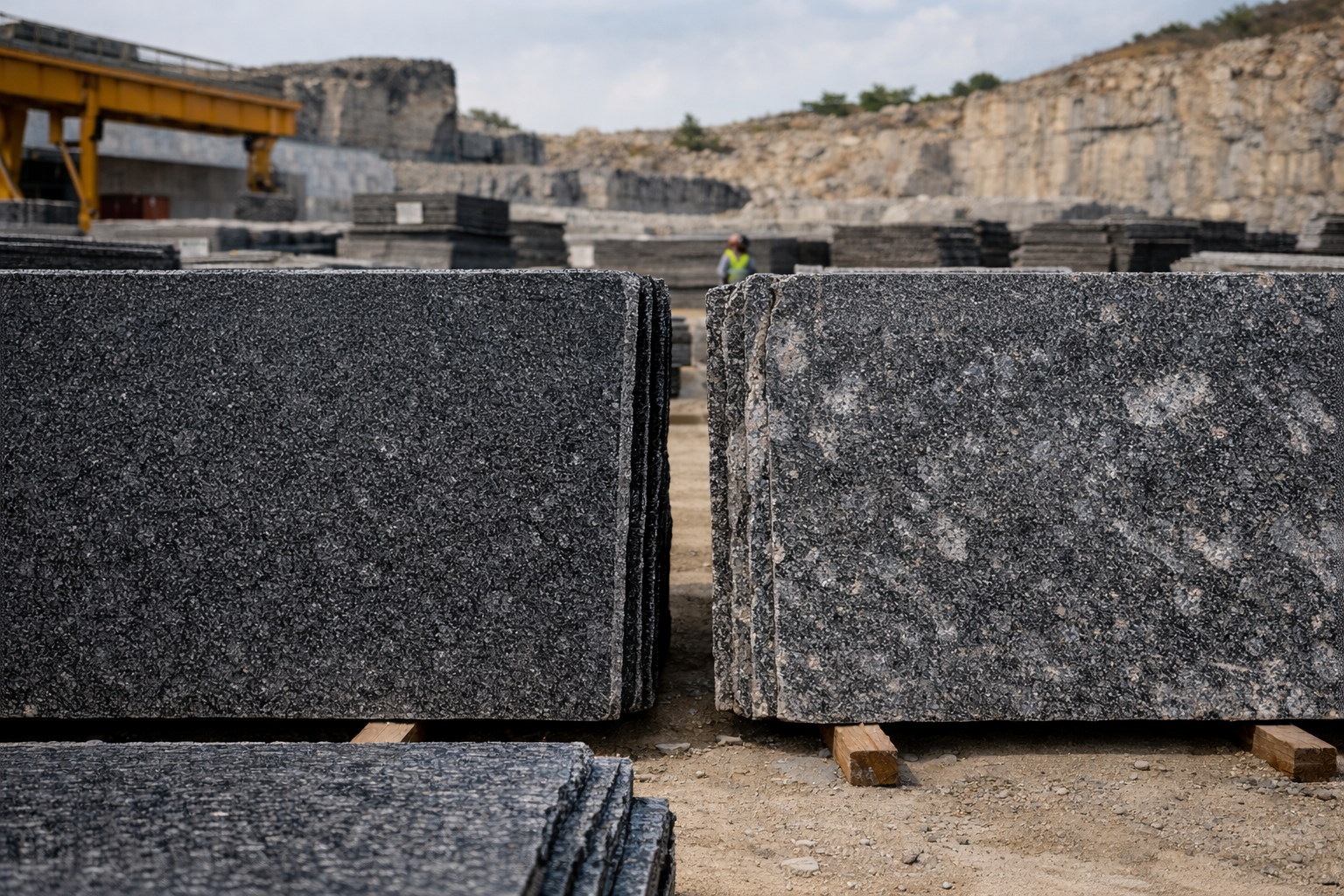
- Rustenburg Granite (Nero Impala) — The market leader. A dark charcoal-grey with silver mineral flecks that works with virtually any kitchen design, from contemporary to classic. Available in K2 (warmer) and Sonop (cooler, darker) variations.
- Zimbabwe Black — A deep, uniform black for sleek modern kitchens. Premium pricing but delivers a striking minimalist aesthetic.
- Rain Forest Green — A dramatic exotic stone with vivid green and brown veining. A statement material for high-end bespoke kitchens.
- Patagonia — Warm earth tones with bold natural patterning. Each slab is unique, making it ideal for clients seeking one-of-a-kind countertops.
- Calacatta D'Oro Quartzite — A natural quartzite with the appearance of Italian marble but the hardness and durability of granite. White-gold veining on a warm base.
Porosity and Stain Resistance
Granite varies in porosity depending on its mineral composition. Denser granites like Rustenburg and Zimbabwe Black have very low porosity (water absorption below 0.20%), making them highly resistant to staining with minimal sealing required. Lighter-coloured granites and some exotic stones may be more porous and require more frequent sealing in kitchen applications.
Hardness and Scratch Resistance
All granites rate 6-7 on the Mohs hardness scale, making them highly scratch-resistant in normal kitchen use. You can cut directly on a granite surface without damage to the stone (though it will dull knife blades — always recommend cutting boards to your clients).
Thickness Options
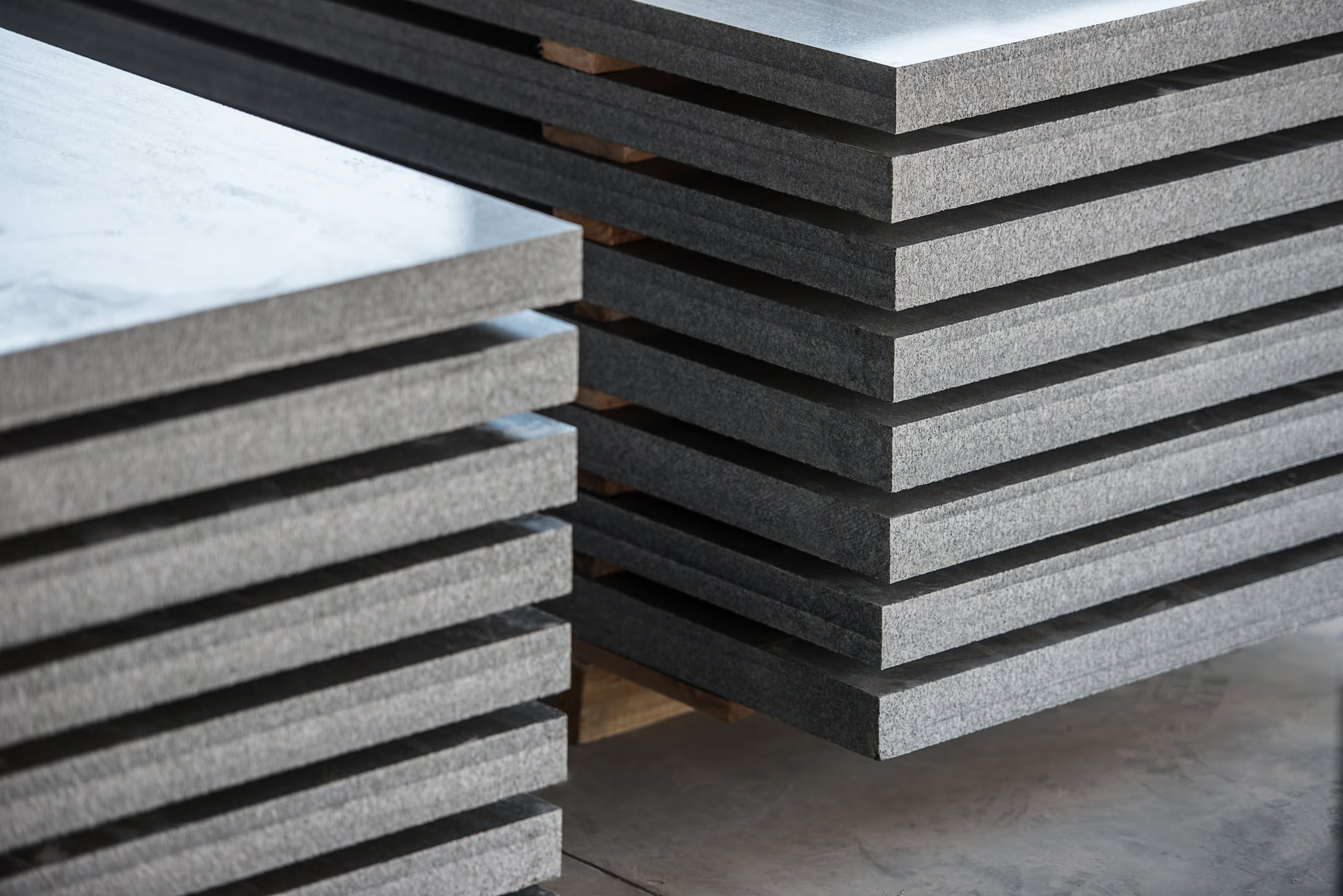
Granite kitchen countertops are manufactured in two standard thicknesses:
20 mm
The standard thickness for most residential kitchen countertops. A 20 mm slab provides excellent structural performance for spans up to 400 mm without support. It is lighter than 30 mm, reducing structural load on cabinetry and simplifying installation. Most kitchen companies and fabricators prefer 20 mm for its balance of performance, weight, and cost.
30 mm
A premium thickness that creates a more substantial visual presence. 30 mm slabs are specified for high-end kitchens, island tops, and applications where an overhang exceeds 400 mm. The additional thickness provides greater impact resistance and a more luxurious aesthetic. Some designers specify 30 mm for the island and 20 mm for perimeter counters as a design contrast.
Laminated Edges
For clients who want the visual impact of a thick countertop without the full cost and weight of 30 mm material, fabricators can laminate two layers of 20 mm granite along the front edge to create a 40 mm edge profile. This technique is common in the South African market and provides an impressive edge thickness at a competitive price point.
Edge Profile Options
The edge profile is one of the most visible design elements of a kitchen countertop. Common profiles include:
Pencil Round (Eased Edge)
A simple, slightly rounded edge that removes the sharp 90-degree corner. The most popular profile for contemporary kitchens. Clean, understated, and cost-effective. This is the default recommendation for most residential projects.
Bullnose (Half Bullnose)
A fully rounded edge creating a smooth, curved profile. Classic and timeless, commonly specified for traditional kitchen designs and public-facing commercial counters. Comfortable to lean against and safe for families with young children.
Ogee
An S-shaped decorative profile that creates an elegant, classical appearance. Specified for formal, traditional kitchens and luxury residential projects. More expensive to fabricate due to the multi-step profiling process.
Bevel
A 45-degree chamfer cut into the top edge, creating a geometric, modern look. Works well with thicker slabs (30 mm or laminated edges) where the bevel accentuates the material depth. Popular in contemporary and industrial kitchen designs.
Square (Flat Polish)
A crisp 90-degree edge with polished faces. The most contemporary profile, delivering a sharp, architectural look. Requires careful handling during fabrication and installation as the sharp corners are vulnerable to chipping.
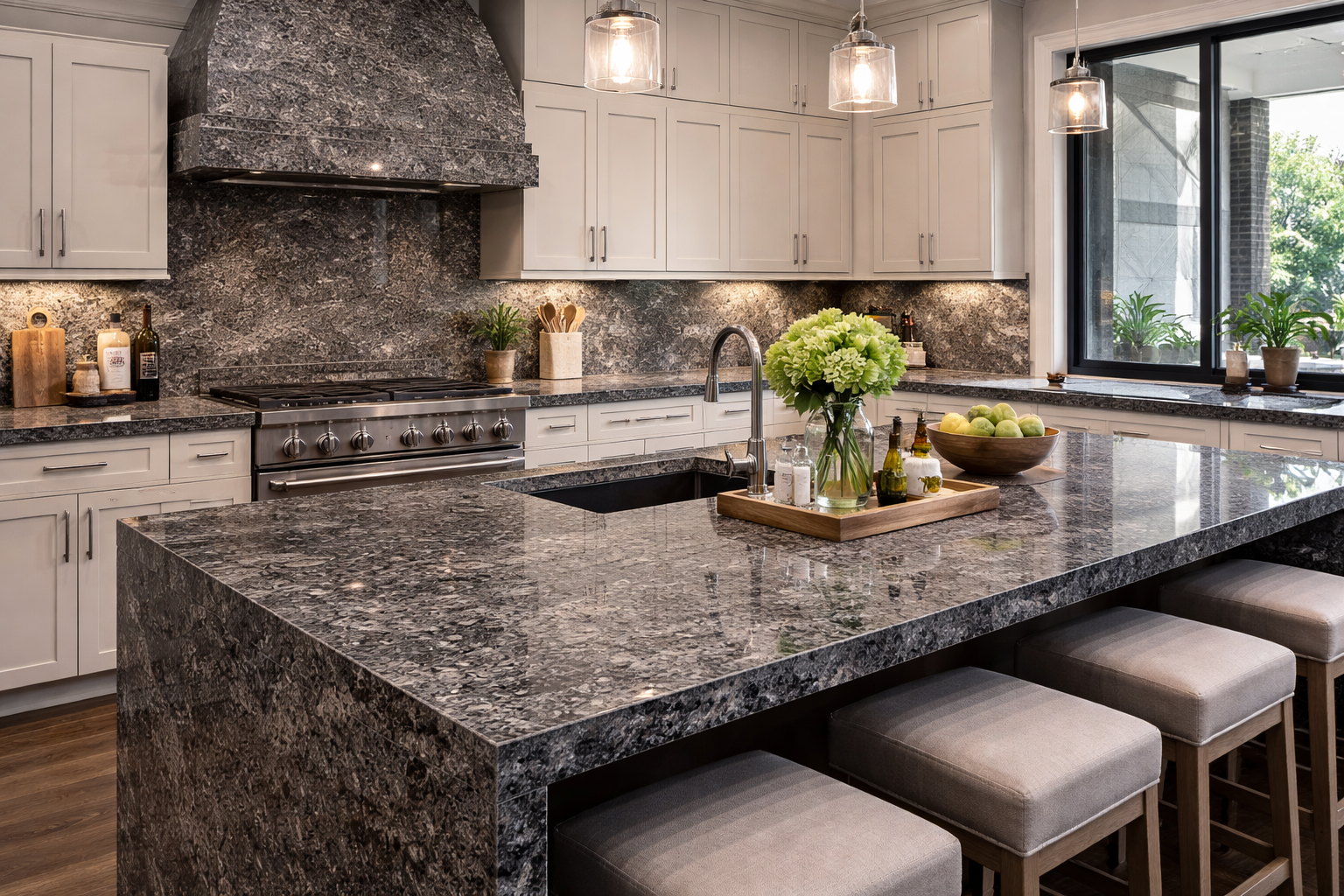
Waterfall Edge
Not technically an edge profile but a design technique where the countertop slab continues vertically down the side of an island or peninsula, creating a continuous stone surface. Waterfall edges require precise mitre cutting and bonding by experienced fabricators. The result is a dramatic, gallery-quality finish.
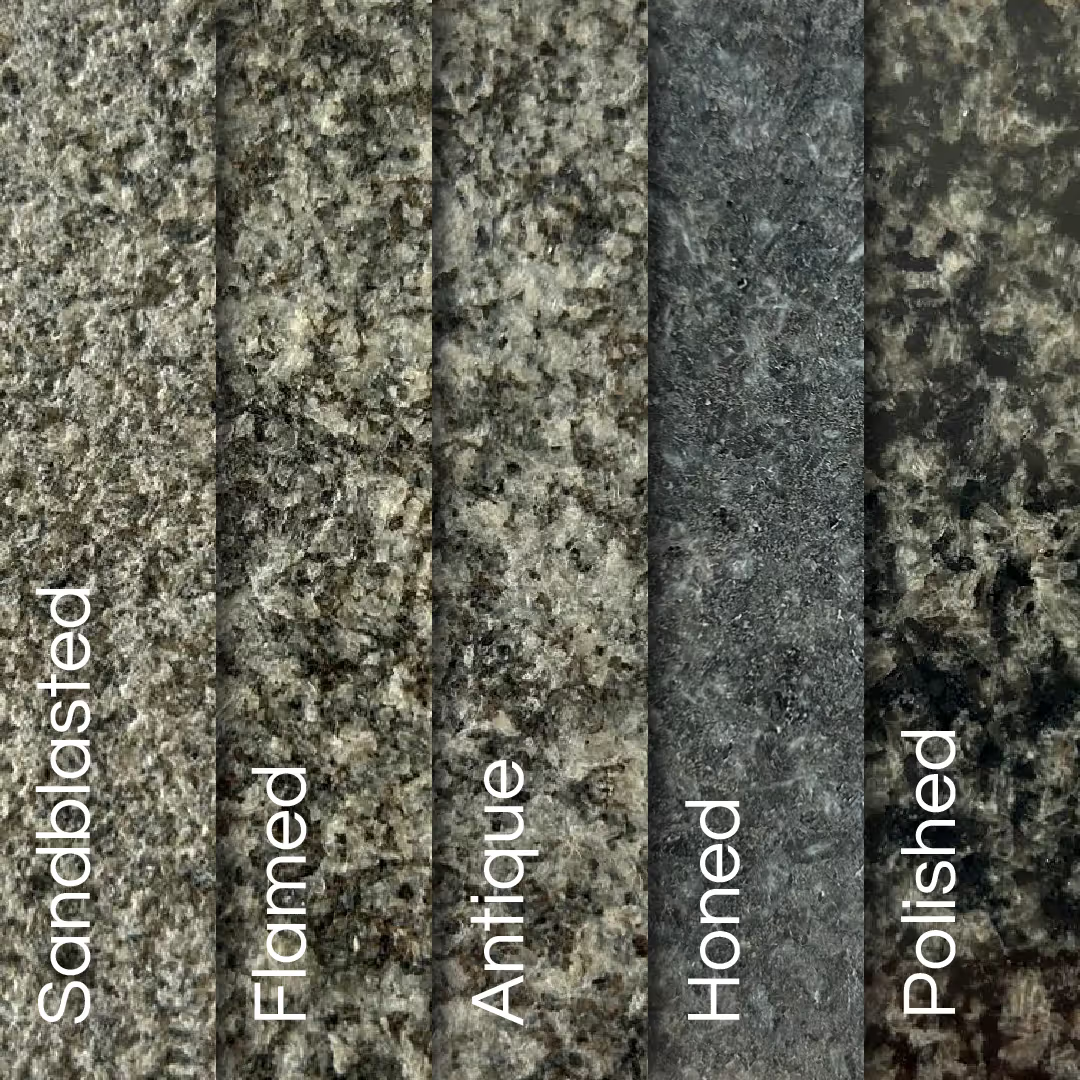
Surface Finishes for Kitchen Countertops
Polished
The standard finish for kitchen countertops. Polished granite has a high-gloss, reflective surface that showcases the stone's colour depth and mineral character. Easy to clean, stain-resistant, and the most popular choice across all market segments.
Honed (Matte)
A smooth but non-reflective finish that creates a sophisticated, contemporary aesthetic. Honed countertops have a softer visual presence and hide fingerprints better than polished surfaces. However, they may require more frequent sealing as the open surface pores are slightly more susceptible to staining.
Leather (Textured)
A lightly textured finish with a soft sheen, created by brushing the stone surface. Leather-finish countertops offer a tactile quality and mask fingerprints effectively. Increasingly popular in modern kitchen designs, particularly with darker granites.
Installation Best Practices
For fabricators and kitchen companies, proper installation is as important as material selection:
- Template before cutting — Always template the kitchen on-site using digital or physical templating methods. Never cut from plan drawings alone, as built dimensions rarely match architectural drawings exactly.
- Support spans — Ensure adequate cabinet support for the countertop weight. 20 mm granite weighs approximately 54 kg/m²; 30 mm weighs approximately 81 kg/m². Islands and breakfast bars with overhangs exceeding 300 mm require steel brackets or corbels.
- Join placement — Plan seam locations at natural break points (behind sinks, at corners) where they will be least visible. Use colour-matched epoxy for seamless joints.
- Sink cutouts — Undermount sinks require reinforcement around the cutout, particularly with 20 mm slabs. Apply mesh reinforcement or steel rodding beneath the cutout to prevent cracking during use.
- Sealing — Apply a quality penetrating sealer after installation. Reapply annually for optimal stain protection, particularly around sink and hob areas.
- Hob cutouts — Maintain a minimum of 50 mm of granite between the hob cutout and any edge or join to prevent thermal stress cracking.
Why Source Countertop Granite from ANG
Afrika National Granite offers kitchen companies and fabricators several advantages:
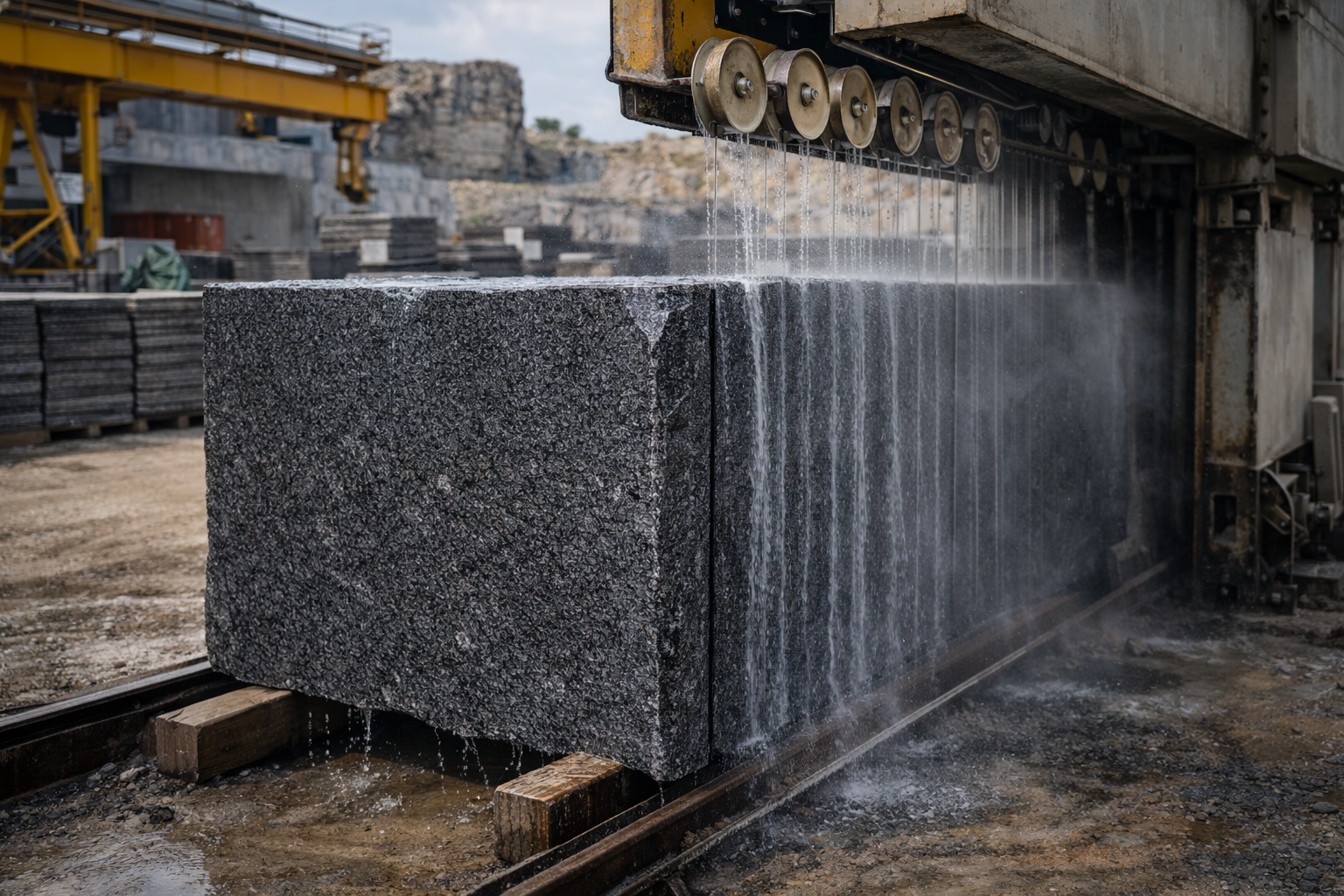
- Direct-from-quarry pricing — We own our Rustenburg quarries and manufacture slabs on-site, eliminating distributor markups
- Consistent stock — Polished 20 mm and 30 mm Rustenburg slabs are our core product, maintained in continuous stock
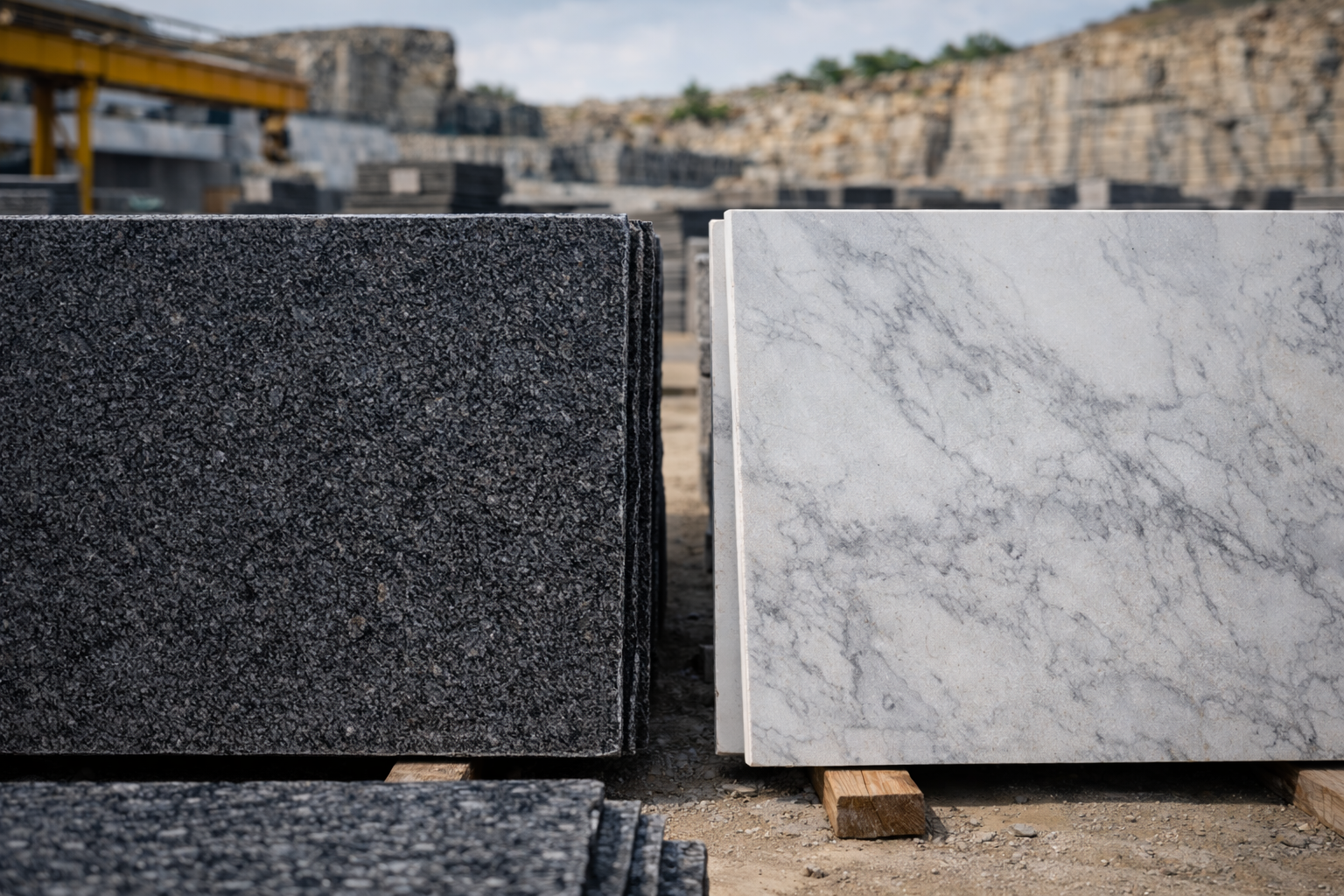
- Exotic materials — Rain Forest Green, Patagonia, Calacatta D'Oro and more — available without the prohibitive cost of importing a full container
- Cut-to-size service — We can supply slabs or pre-cut countertop blanks to your specifications
- Quality grading — First-choice material for export and premium projects; competitive pricing on second-choice for domestic projects
Visit Our Showroom
Select your countertop material in person at our facility at 8 Dekenah Road, Alrode, Alberton. Walk through our slab yard, compare materials and finishes side by side, and get a competitive quotation from our team. Contact Afrika National Granite today to discuss your kitchen countertop requirements.