The Case for Granite Driveways
A driveway is one of the most demanding paving applications in any project. It must support the concentrated loads of vehicles, resist the abrasion of tyres, withstand oil and chemical exposure, endure seasonal temperature extremes, and maintain its appearance for decades with minimal maintenance. Natural granite meets every one of these requirements and adds something that no manufactured paving material can replicate: the visual depth, texture, and permanence of real stone.
For landscape architects, paving contractors, property developers, and homeowners, granite driveways represent a premium investment that pays dividends in durability, kerb appeal, and property value. This guide covers the technical specifications and design considerations for granite in vehicular applications.
Material Selection for Vehicular Paving
Not all granite products are suitable for driveways. The material must be specified with sufficient thickness and the correct surface finish to perform safely under vehicle loads.
Granite Cobblestones for Driveways
Cobblestones are the classic choice for granite driveways, offering timeless aesthetic appeal and exceptional structural performance:
- 100 x 100 x 100 mm cubes — The standard European cobblestone format. Suitable for residential driveways with passenger vehicle traffic. Provides excellent interlock when laid in fan or herringbone patterns.
- 200 x 100 x 100 mm setts — A larger format that provides greater interlock strength and faster installation coverage. Suitable for both residential and commercial vehicular areas.
- Cropped (hand-dressed) cobbles — Cobbles with slightly irregular faces that create a traditional, heritage appearance. The irregularity adds character but requires more skilled installation.
- Sawn cobbles — Machine-cut cobbles with precise dimensions and flat faces. Create a cleaner, more contemporary driveway aesthetic with tighter joints.
Granite Pavers for Driveways
Flat-sawn granite pavers offer a more contemporary alternative to cobblestones:
- 200 x 100 x 60 mm — Standard brick-format paver for residential driveways. Minimum 60 mm thickness is required for light vehicular traffic.
- 200 x 100 x 80 mm — Heavy-duty paver for driveways with regular vehicle traffic or occasional heavy vehicles.
- 300 x 150 x 60 mm or 400 x 200 x 80 mm — Larger format pavers for a modern aesthetic. Require careful sub-base design as the larger surface area distributes less interlock force.
Load Ratings and Structural Design
Understanding Vehicle Loads
The structural design of a granite driveway must account for the loads it will carry:
- Passenger vehicles: Axle loads of 1,000-2,000 kg. A standard residential driveway specification.
- Light commercial vehicles (LCVs): Axle loads of 2,000-4,500 kg. Delivery vehicles, bakkies, and small trucks.
- Heavy vehicles: Axle loads exceeding 4,500 kg. Refuse collection vehicles, fire engines, and construction traffic. Requires heavy-duty sub-base design.
Granite Compressive Strength
The granite paver or cobble itself is never the weak point in a driveway system. Rustenburg granite has a compressive strength of 180-260 MPa — far exceeding the contact pressures generated by any vehicle tyre. The critical design factors are paver thickness, laying pattern (interlock), bedding layer, and sub-base construction.
Sub-Base Design
The sub-base is the foundation of any granite driveway. Its design depends on the expected traffic loading and the native ground conditions:
Residential Driveways (Passenger Vehicles)
- Excavate to a depth of 250-300 mm below finished level
- Compact the subgrade (natural ground) to 95% Mod AASHTO density
- Install geotextile fabric if ground conditions are poor (clay, high water table)
- 150 mm compacted G5 or crusher run sub-base, laid in two lifts and compacted
- 25-30 mm bedding layer of sharp sand or 5 mm crusher dust, screeded to level
- Granite pavers/cobbles laid on bedding layer
Commercial or Heavy-Traffic Driveways
- Excavate to 350-450 mm below finished level
- Geotextile separation layer
- 200-250 mm compacted G2 or G4 crushed stone sub-base in three lifts
- 50 mm G5 levelling course
- 25-30 mm bedding layer
- 80 mm minimum granite pavers or 100 mm cobblestones
Laying Patterns for Maximum Interlock
The laying pattern directly affects the structural performance of the driveway. Patterns that create strong interlock between pavers distribute vehicle loads more effectively and resist creep and settlement.
Herringbone (45-degree or 90-degree)
The strongest pattern for vehicular applications. Each paver is interlocked with its neighbours at an angle, creating a structure that resists movement in all directions. Herringbone is the recommended pattern for all driveways carrying regular vehicle traffic.
Fan (Arc) Pattern
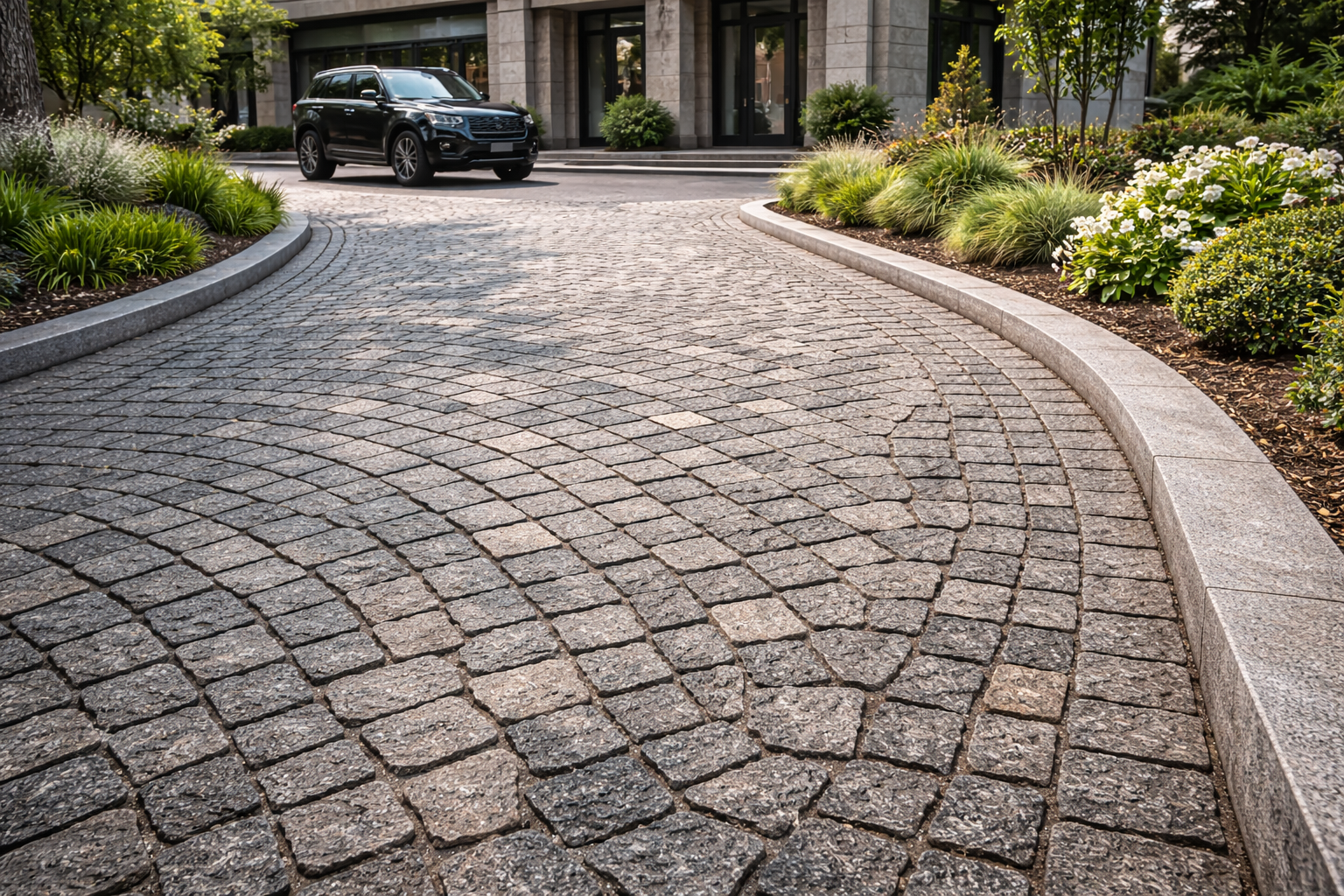
The classic cobblestone pattern for driveways and plazas. Cobbles are laid in concentric arcs radiating from a central point. The fan pattern provides good interlock and creates a visually dramatic surface. It is the traditional pattern for prestigious entrance driveways and motor courts.
Stretcher Bond (Running Bond)
A simple linear pattern where pavers are offset by half their length. Provides moderate interlock — suitable for pedestrian areas and light residential driveways with minimal turning traffic. Not recommended for heavy vehicular use.
Basket Weave
Pairs of pavers laid at alternating 90-degree orientations. An attractive pattern but provides less structural interlock than herringbone. Suitable for decorative residential driveways with light traffic.
Edge Restraint
Every granite driveway requires edge restraint to prevent paver creep. Without edge restraint, vehicle loads and thermal expansion will gradually push pavers outward, opening joints and compromising the surface:
- Granite kerb stones — The premium option. Granite kerbs match the driveway material and provide a clean, integrated edge detail. Typically bedded and haunched in concrete.
- Concealed steel or aluminium edging — L-shaped metal strips pinned into the sub-base. Invisible once installed and the adjacent landscaping is complete.
- Concrete haunch — A mass concrete haunch poured against the outer edge of the paving. The most economical option, typically concealed by soil and planting.
Surface Finish for Driveways
Driveway granite must have a textured finish for vehicle tyre grip and pedestrian safety:
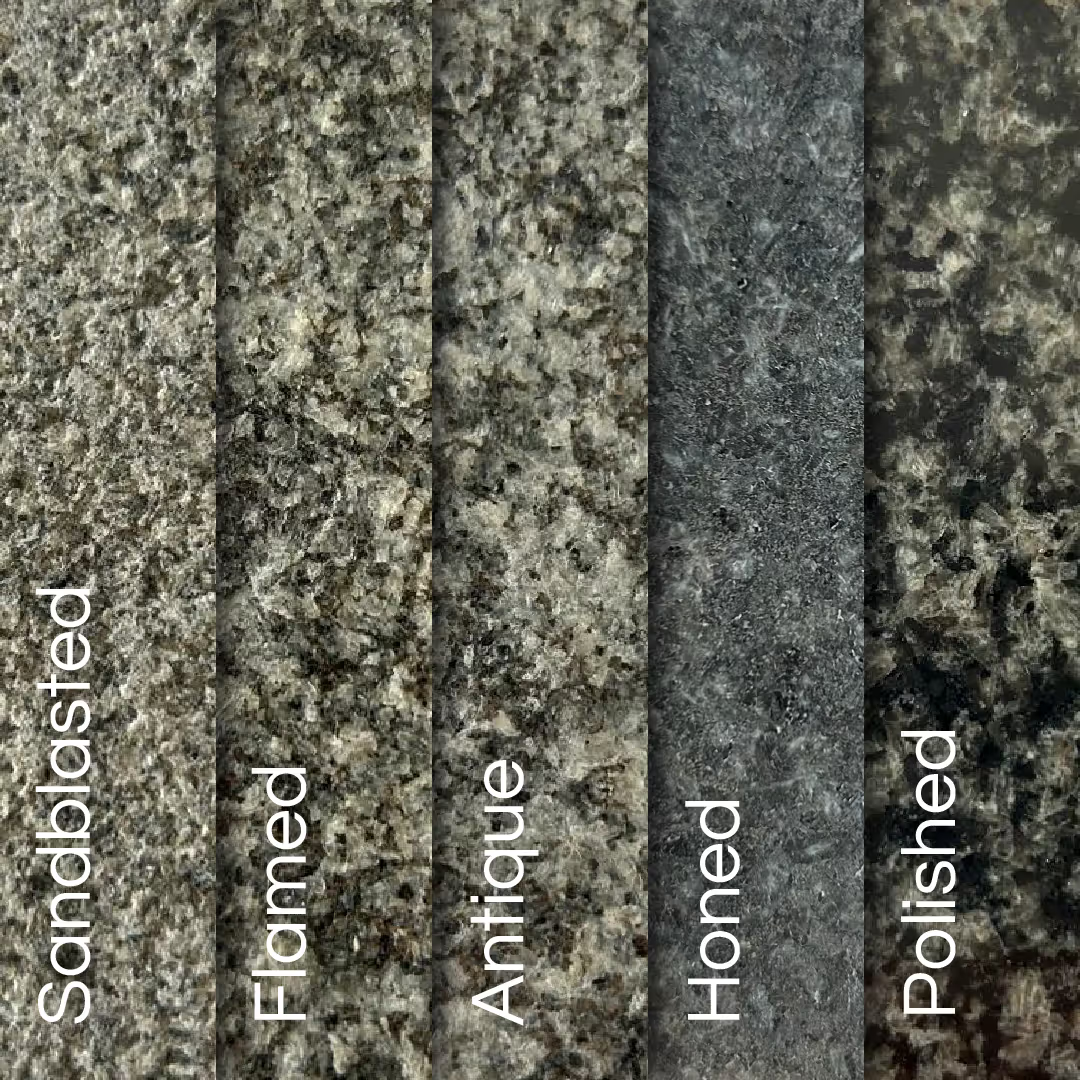
- Flamed — The standard finish for driveway pavers and cobblestones. Provides consistent texture and good tyre grip in all weather conditions.
- Natural split — The traditional cobblestone surface. Rough, irregular, and highly textured. Provides excellent grip but creates a rougher driving surface.
- Bush-hammered — A heavily textured finish for maximum traction. Specified for steep driveways, commercial vehicle areas, and locations where wet conditions are frequent.
- Sawn and sandblasted — A contemporary finish combining clean-cut edges with a textured top surface. Good tyre grip with a modern aesthetic.
Drainage
Granite paving is impermeable, so surface water management is essential:
- Design falls of minimum 1:40 (2.5%) across the driveway surface, draining toward landscaped areas, channels, or drainage gullies
- Install linear channel drains at garage thresholds and where the driveway meets buildings
- If using permeable jointing (open sand joints), some water will drain through the joints into the sub-base — but this should not be relied upon as the primary drainage strategy
- Consider local stormwater regulations — some municipalities require on-site stormwater attenuation for large paved areas
Maintenance
Granite driveways require minimal maintenance:
- Weed control — Polymeric sand in joints inhibits weed growth. If standard sand is used, occasional weed treatment may be needed.
- Re-sanding — Joints may need topping up with sand every 2-3 years as bedding sand settles under traffic.
- Cleaning — Pressure washing annually removes accumulated dirt and restores the stone's natural colour. Avoid pressure washing with a narrow nozzle directly on joints, as this can displace jointing sand.
- Oil stains — Treat promptly with a proprietary stone degreaser. On flamed granite, oil stains are less visible than on polished surfaces.
Supply from Afrika National Granite
ANG manufactures driveway-grade granite products from our own quarries:
- Cobblestones — 100 x 100 x 100 mm cubes, 200 x 100 x 100 mm setts, cropped and sawn finishes
- Pavers — 60 mm and 80 mm thickness in standard and custom sizes
- Kerb stones — Straight and radius profiles for driveway edging
- Volume pricing for contractors and project buyers
Request a Quotation
Visit our manufacturing facility at 8 Dekenah Road, Alrode, Alberton to view our driveway product range and discuss your project requirements. Afrika National Granite offers direct-from-quarry pricing and consistent stock availability for driveway projects of all sizes. Contact us today for a competitive quotation.