%2520(1).avif)
How Granite Gets from Ground to Project
Every granite countertop, tombstone, paving stone, and cladding panel starts as a raw block extracted from a quarry. Between that quarry face and your workshop or project site, the stone passes through a supply chain that can include as few as two steps or as many as six. Each step adds cost, lead time, and potential quality variation. Understanding this supply chain helps you make better purchasing decisions — whether you are a fabricator buying weekly, a contractor sourcing for a specific project, or a distributor building your own inventory.
The Granite Supply Chain: Step by Step
Step 1: Quarry Extraction
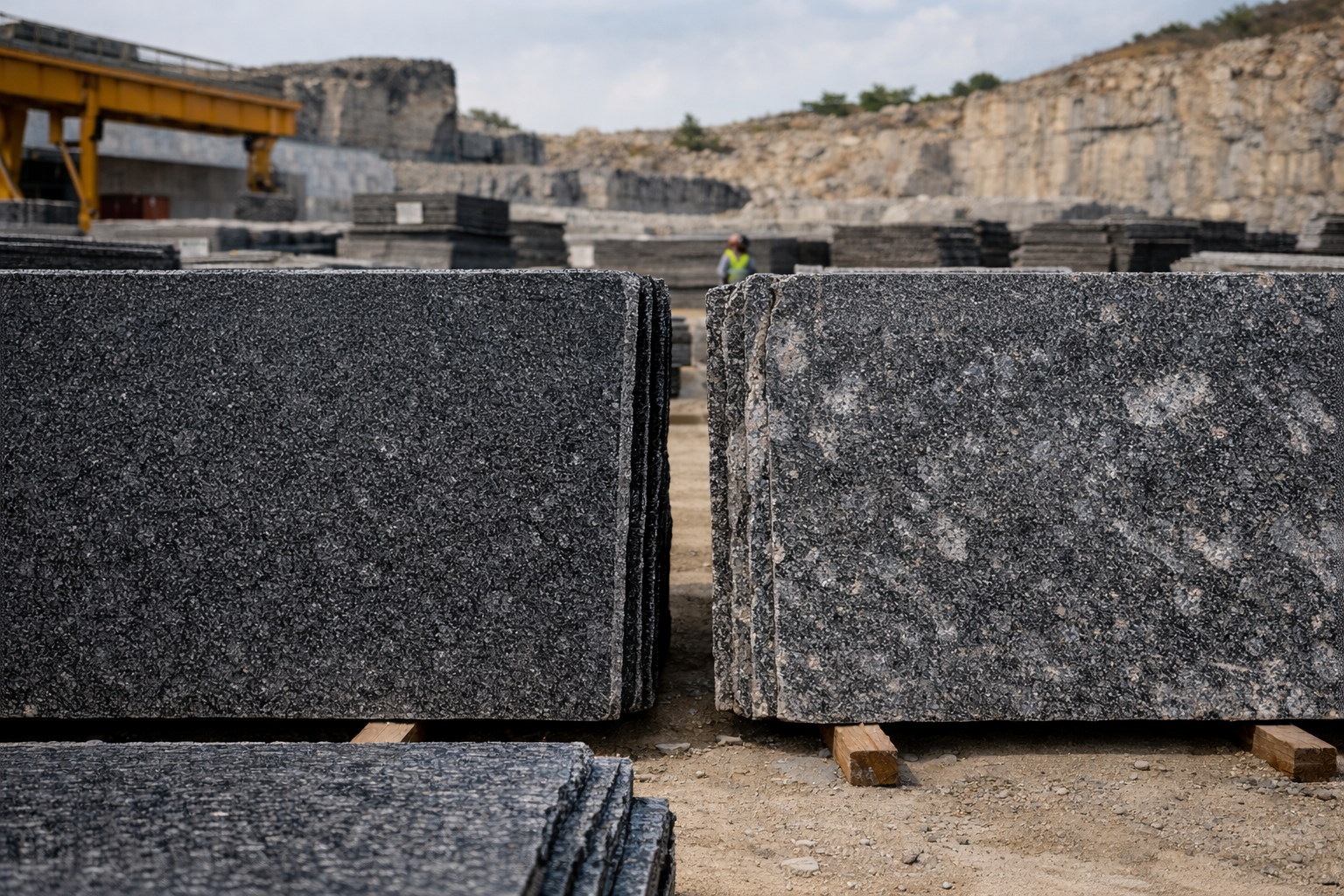
Granite is extracted from open-pit quarries using diamond wire cutting and controlled blasting to separate large blocks from the quarry face. Block sizes typically range from 2 to 20 tonnes depending on the quarry geology and the intended product. The quality of the raw block — its colour consistency, structural integrity, and mineral distribution — is determined at this stage. Poor block selection leads to poor slabs, regardless of what happens downstream.
Step 2: Block Processing (Slab Manufacturing)
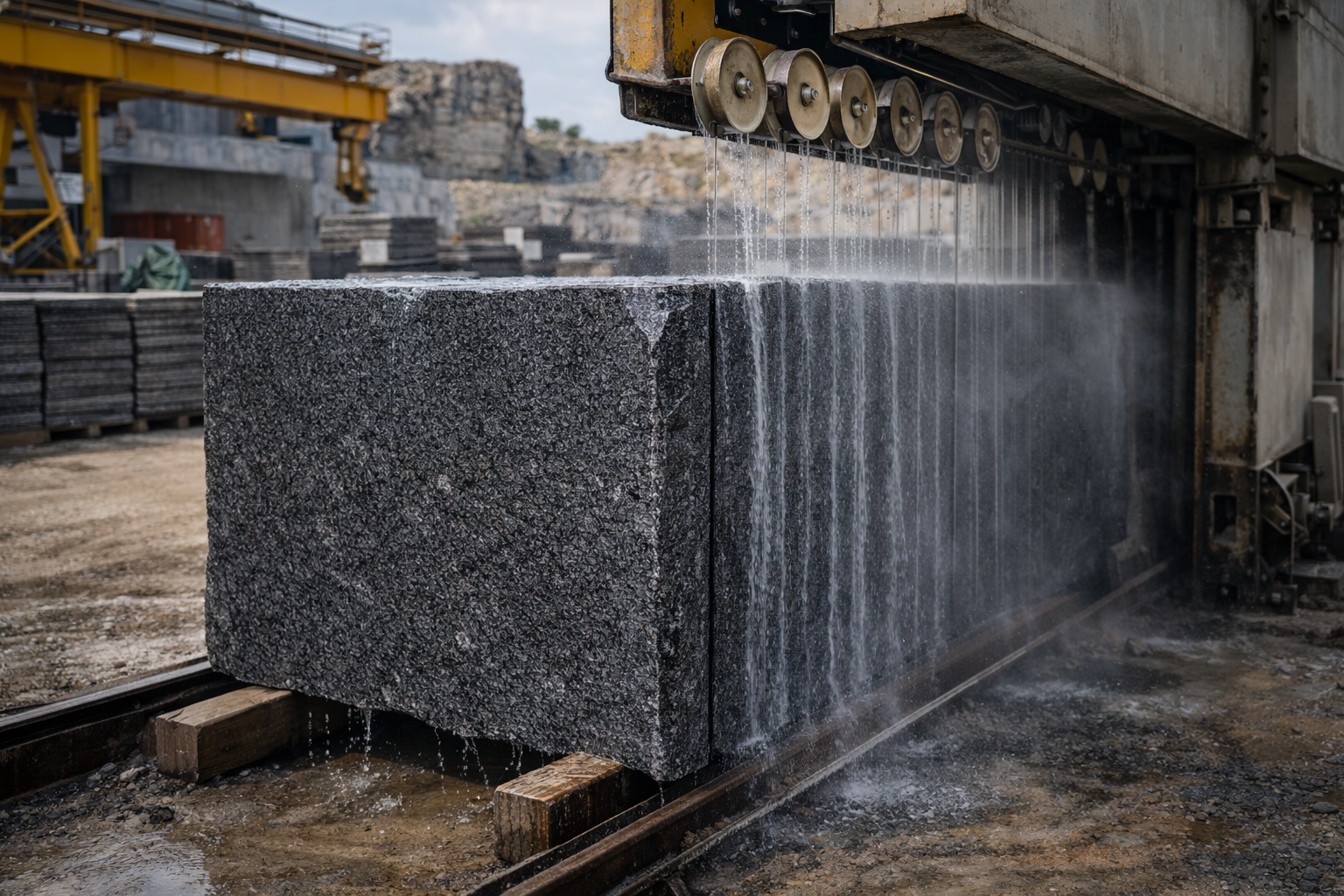
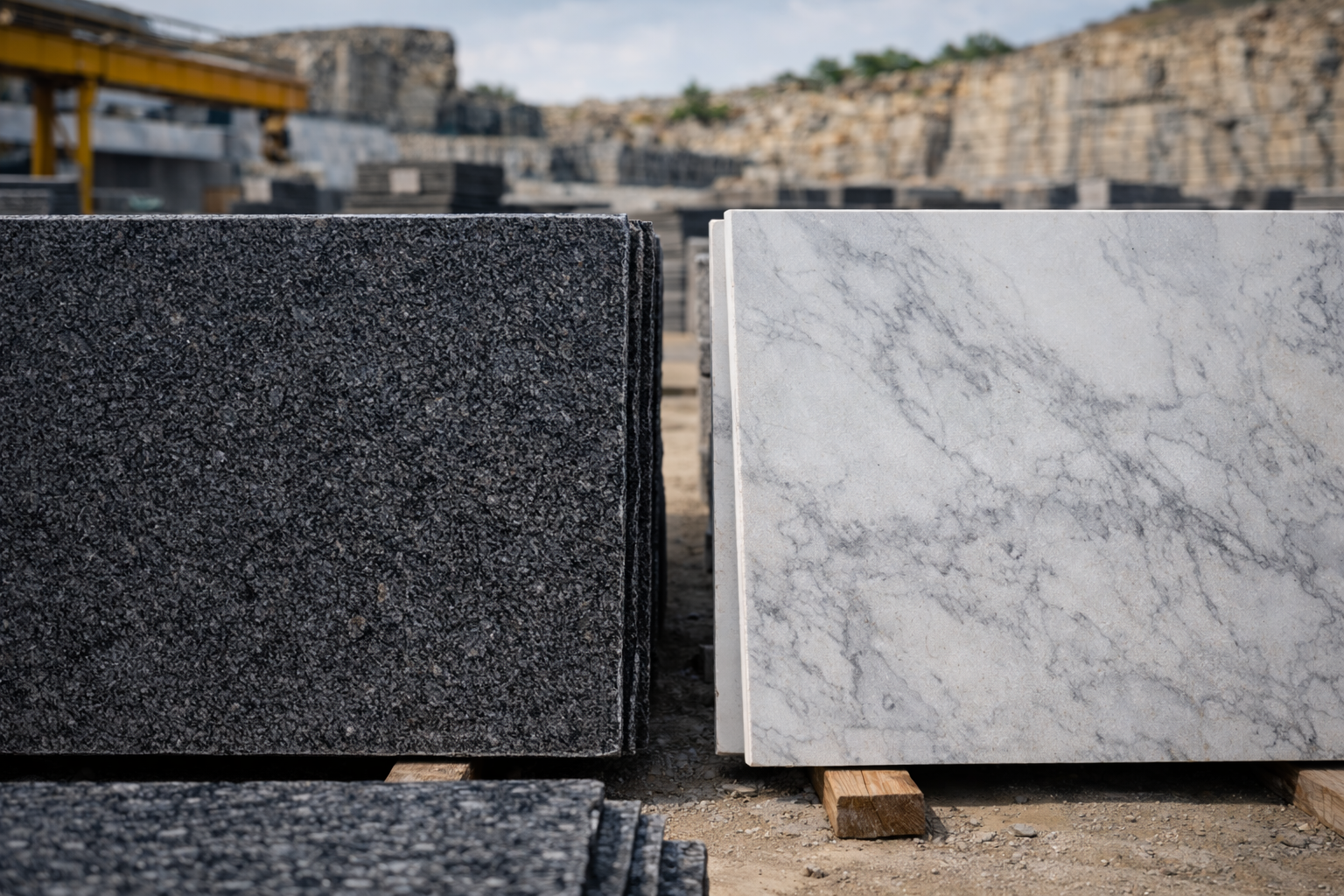
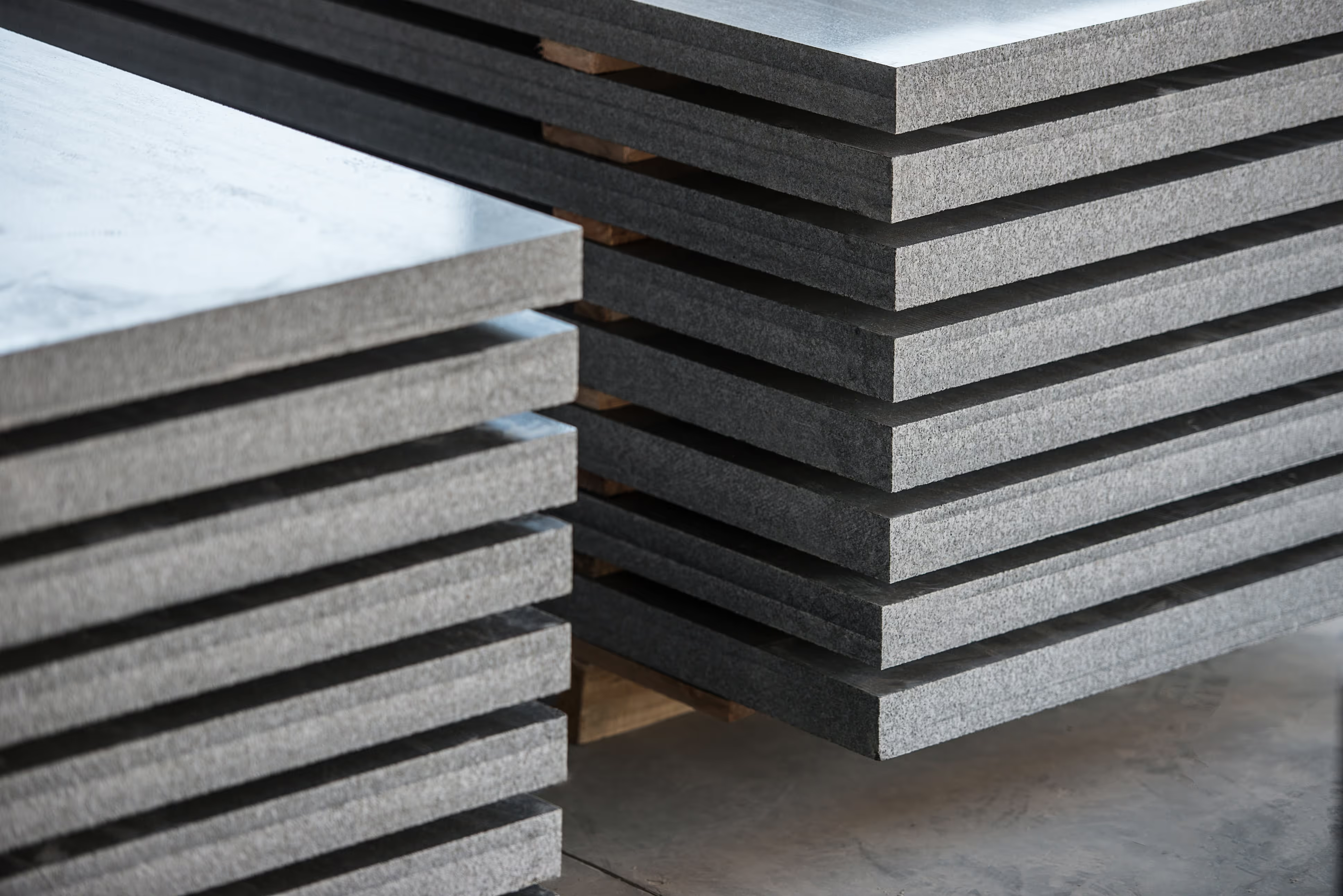
Raw blocks are transported from the quarry to a processing facility where they are cut into slabs using gang saws or multi-wire saws. Slab thickness is determined at this stage (typically 20mm or 30mm for standard products). After cutting, slabs are graded for quality — first choice, second choice, or reject — based on visual inspection and measurement.
Step 3: Surface Finishing
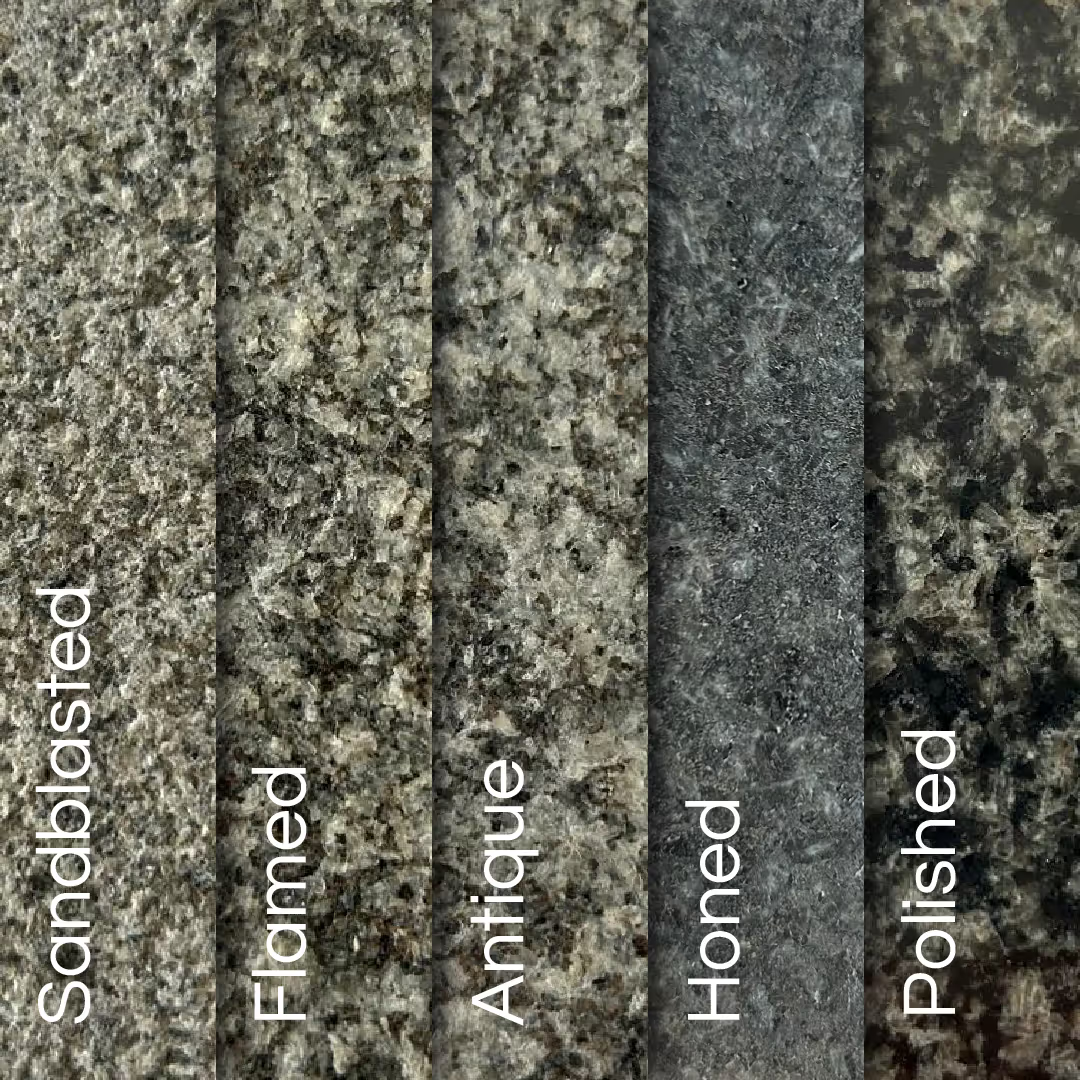
Slabs receive their surface finish (polished, honed, flamed, brushed, bush-hammered, or sandblasted) using automated processing lines. The finish is applied to the full slab before it enters inventory or is sold.
Step 4: Inventory and Distribution
Finished slabs enter the manufacturer's inventory for sale to distributors, fabricators, and other buyers. Some slabs are sold as full slabs; others are processed further into cut-to-size components, tiles, pavers, or other products before sale.
Step 5: Secondary Distribution (Optional)
In many markets, slabs pass through one or more distributors before reaching the end fabricator or contractor. Each distributor adds a margin, typically 15–30% depending on the market and the level of service they provide (warehousing, local delivery, credit terms, technical support).
Step 6: Fabrication and Installation
The fabricator cuts, edges, and finishes the slab into the final product (countertop, tombstone, cladding panel, etc.) and either sells it to the end customer or installs it as part of a project.
Route A: Buying Direct from a Quarry Owner-Manufacturer
When you buy from a company that owns its quarries and operates its own slab manufacturing facility, you are collapsing steps 1 through 4 into a single supplier relationship. This is the model operated by Afrika National Granite.
Pricing Advantages
The most obvious advantage is pricing. Every intermediary between the quarry and your workshop adds margin. When you buy direct from the quarry owner-manufacturer, there is no quarry-to-manufacturer markup (they are the same entity), no manufacturer-to-distributor markup, and no distributor-to-retailer markup. The price you pay reflects the actual cost of extraction, processing, and finishing, plus a single margin. For volume buyers — fabricators purchasing regularly, distributors building inventory, monument manufacturers with standing orders — this pricing advantage compounds over time into significant savings.
Quality Control
A vertically integrated supplier controls quality from the quarry face through to the finished slab. They select which blocks to extract, they grade the slabs they cut, and they apply the finish to their own production. There is no opportunity for quality to be compromised by a middleman substituting lower-grade material or for grading standards to be interpreted differently at different points in the chain. When you have a quality issue with a quarry owner-manufacturer, you are dealing directly with the people who extracted and processed the stone. There is no finger-pointing between quarry, manufacturer, and distributor.
Supply Consistency
Quarry owners have direct control over their extraction schedule. If demand for a particular product increases, they can adjust quarry operations to produce more of the required block type. Distributors, by contrast, can only sell what they have been able to purchase from their own suppliers — and when those suppliers have stock shortages, the distributor has no way to accelerate supply.
Customisation Flexibility
Because the quarry owner-manufacturer controls the entire production process, they can accommodate custom requests more readily. Non-standard slab sizes, special finish combinations, custom cut-to-size components, and bespoke products can be produced to order without the logistical complexity of coordinating between separate quarry, manufacturing, and finishing operations.
Potential Limitations
Direct-from-quarry buying is not always the best route. Minimum order quantities may apply, particularly for export orders where full container loads are the standard minimum. Geographic distance can make logistics expensive for buyers far from the processing facility. Product range is limited to what that specific quarry produces — a Rustenburg granite quarry owner cannot supply Indian or Chinese granite varieties. And credit terms may be less flexible than established distributors who specialise in trade finance.
Route B: Buying Through a Distributor
Distributors serve an important function in the granite supply chain, particularly for buyers whose requirements do not align with the direct-from-quarry model.
Advantages of Distributors
Distributors aggregate products from multiple sources, offering a broader product range from a single point of purchase. A distributor may stock Rustenburg granite alongside Indian, Chinese, Brazilian, and European varieties. For fabricators who need multiple stone types for different projects, a distributor with diverse inventory saves the complexity of managing relationships with multiple quarries. Distributors also provide local warehousing, meaning you can inspect and collect material immediately rather than waiting for production. They often offer more flexible credit terms than manufacturers, extending 30–60 day payment terms to established customers. And for small-volume buyers, distributors are often more accessible — they will sell a single slab where a manufacturer may require a minimum order.
Disadvantages of Distributors
Every advantage of the distributor model comes at a cost — literally. Distributor margins add 15–30% to the price compared to direct-from-quarry purchasing. This is the cost of convenience, variety, and flexible terms. Quality control is one step removed. The distributor grades and sells material they did not produce. While reputable distributors maintain strict quality standards, the buyer is relying on the distributor's judgement rather than the manufacturer's. Supply is dependent on the distributor's ability to source from their own suppliers. When a distributor's upstream supplier has a stock-out, the distributor has no way to produce more material. And product knowledge may be more general. A distributor stocking 50 varieties from 15 countries may not have the deep product knowledge of a manufacturer who produces and sells their own stone.
Which Route for Which Buyer?
Fabricators Buying One Primary Stone Type Regularly
If your workshop primarily uses Rustenburg granite and you purchase weekly or monthly, buying direct from the quarry owner-manufacturer is almost always the better option. The pricing advantage on your core material will far outweigh any convenience benefit of going through a distributor.
Fabricators Needing Multiple Stone Types
If your project mix requires Rustenburg granite for some jobs and Indian or Chinese granite for others, you may benefit from a dual-source strategy — buying your core volume directly from a quarry owner-manufacturer and supplementing with distributor purchases for specialty or low-volume materials.
Distributors Building Inventory
If you are a distributor, buying direct from quarry owner-manufacturers is essential for competitive pricing. Your margin depends on the gap between your purchase price and your selling price, and buying through another distributor compresses that margin to unsustainable levels.
Monument Manufacturers
Monument manufacturers need consistent supply of matching components. A quarry owner-manufacturer who can supply headstones, bases, landings, and kerbing from the same production batch is the ideal source. Buying components from different distributors risks colour mismatch across the memorial set.
One-Off Project Buyers
For a single project requiring a small quantity of granite, a local distributor may be the most practical option. The convenience of immediate availability and single-slab purchases outweighs the pricing premium for a one-time purchase.
International Buyers
For international importers, buying direct from the quarry owner-manufacturer is the standard practice. The pricing advantage is magnified by the volumes involved (full container loads), and direct quality control is critical when the material will travel thousands of kilometres before being inspected by the buyer.
ANG: A Vertically Integrated Supply Partner
Afrika National Granite operates across the full supply chain — from quarry ownership through slab manufacturing, surface finishing, and cut-to-size processing at our Alrode facility. We supply directly to fabricators, distributors, monument manufacturers, contractors, architects, and the public, eliminating intermediary markups and giving you direct access to the source of the material.
Whether you are a volume buyer looking for the best possible pricing on Rustenburg granite, or a first-time buyer who wants to understand what you are purchasing and where it comes from, we welcome you to visit our factory at 8 Dekenah Road, Alrode, Alberton, or contact us for a quote.